Bartholomew Roberts
History · sources at the end · the game’s fiction is kept separately
He joined the pirates unwillingly in 1719 and became, by number of prizes, the most successful of them all.
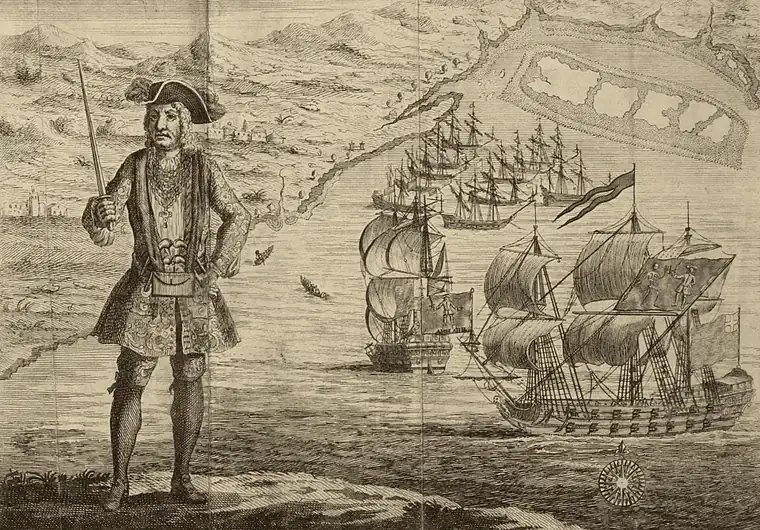
| Born | John Robert, about 1682, near Haverfordwest, Pembrokeshire, Wales |
| Active | June 1719 – February 1722 |
| Ships | The Royal Rover, then several ships named Royal Fortune |
| Died | 10 February 1722, off Cape Lopez (now Gabon) |
Taken by pirates
Roberts was born in Casnewydd Bach, a small village in Pembrokeshire, probably as John Robert, and went to sea young. In June 1719 he was second mate of the slave ship Princess at Anomabu on the Gold Coast when the pirate Howell Davis, another Welshman, captured it. Roberts was forced to join. Within weeks Davis was killed in an ambush on the Portuguese island of Príncipe, and the crew elected Roberts captain. Johnson’s General History says he accepted because, if he must be a pirate, it was better to be a commander than a common man.
Brazil and the north
He took revenge on Príncipe, then crossed to Brazil. In late 1719, off Bahia, he slipped into a Portuguese convoy of over forty merchant ships waiting for escort and carried off its richest vessel, loaded with gold coin, jewels and goods. While he chased another prize, his lieutenant Walter Kennedy sailed away with the treasure ship, a betrayal that, according to Johnson, led Roberts to stop admitting Irishmen and to write strict articles.
In 1720 he worked the coast of North America. In June he entered Trepassey harbour in Newfoundland and took or burned over twenty vessels without a fight, including fishing boats and a ship he kept for himself. He then raided the West Indies, where his crews took many ships at St Kitts, Martinique and Guadeloupe. His second flag, showing him standing on two skulls marked “ABH” and “AMH” (“A Barbadian’s Head” and “A Martinican’s Head”), advertised his hatred of the governors of those islands, who had sent ships after him.
Africa and the end
By 1721 the Caribbean was too hot, and Roberts sailed to West Africa, the busiest coast of the slave trade. At Whydah (Ouidah) in January 1722 he held a crowded harbour to ransom. The Royal Navy had sent two warships, HMS Swallow and HMS Weymouth, to the coast. Swallow, under Captain Chaloner Ogle, found Roberts careening near Cape Lopez. On 10 February 1722, as Swallow closed, Roberts was killed by grapeshot to the throat. His crew threw his body overboard, still in his finery, as he had asked.
His men surrendered. At Cape Coast Castle in April 1722, the largest pirate trial of the age condemned 54 men; 52 were hanged, about 20 were sentenced to serve in the Royal African Company’s mines, and 74 were acquitted, many of them forced men. The trial is often treated as the beginning of the end of the Golden Age.
Character and articles
Roberts is said to have taken more than 400 ships, a number that cannot be checked but which no rival approaches. Johnson portrays a tall, dark, well-dressed man who drank tea, disliked drunkenness at sea, and kept the sabbath for his musicians. The articles printed for his crew are the fullest surviving pirate code. They covered votes, fair shares, a ban on gambling for money, lights out at eight, and compensation for injury. See pirate articles and pirate pay and shares. Johnson also gives him the line “a merry life and a short one shall be my motto”, which may be the author’s own phrasing.
Roberts never sailed from Nassau. He came after the Republic of Pirates had fallen, which is part of why he roamed so widely.
In the game
Roberts is not a playable captain in Free Nassau, which is set in 1716–1718, before his career began. You can sail with Blackbeard, Bellamy, Vane and others.
Sources and further reading
- Captain Charles Johnson, A General History of the Pyrates (London, 1724), chapter on Roberts. Project Gutenberg.
- Aubrey Burl, Black Barty: Bartholomew Roberts and His Pirate Crew 1718–1723 (Sutton, 2006).
- Marcus Rediker, Villains of All Nations (Beacon Press, 2004).
- A Full and Exact Account of the Tryal of all the Pyrates Lately Taken by Captain Ogle (London, 1723).