The Golden Age of Piracy
History · sources at the end · the game’s fiction is kept separately
For about ten years, a few thousand sailors made the Atlantic world’s sea lanes their own.
| Core period | About 1716–1726 (some historians use a wider span, 1650–1730) |
| Main bases | Nassau, the Carolina and Virginia coasts, Madagascar, West Africa |
| Peak numbers | Perhaps 1,800–2,400 pirates at sea at once, around 1718–1722 |
| Ended by | Pardons, navy patrols, and mass trials and hangings |
What the phrase means
“The Golden Age of Piracy” is a modern label, not a period one. Writers use it in two ways. In the wide sense it covers the buccaneers of the 1660s and 1670s, the “Pirate Round” to the Indian Ocean in the 1690s, and the burst of Atlantic piracy that followed the War of the Spanish Succession. In the narrow sense, the one most historians now mean, it is the decade from about 1716 to 1726. Nearly every famous name belongs to that decade: Blackbeard, Black Sam Bellamy, Charles Vane, Jack Rackham, Anne Bonny and Mary Read, Stede Bonnet, Edward England and Bartholomew Roberts.
Why it began
The war between Britain, the Dutch and their allies on one side and France and Spain on the other ended with the Treaties of Utrecht in 1713 and 1714. During the war, thousands of sailors had served in navies and on privateers, private ships licensed to raid enemy trade. Peace put many of them out of work, and the Royal Navy shrank sharply. Merchant wages fell, while shipboard life stayed hard and dangerous.
Two things turned that pool of idle seamen into a pirate boom. The first was the wreck of the Spanish treasure fleet in 1715 on the Florida coast. Salvagers and raiders from Jamaica and the Bahamas, led by Henry Jennings, attacked the Spanish salvage camp and carried off silver. The second was a base. The Bahamas had no working government, and the harbour at Nassau on New Providence was shallow enough to keep out large warships. From 1716 it became the “Republic of Pirates”, where captains like Benjamin Hornigold trained a generation of younger men.
How pirates operated
Golden Age pirates mostly hunted merchant shipping, not treasure galleons. They wanted sloops and ships that sailed well, plus food, drink, rigging, powder, medicine and men. They usually won by intimidation rather than battle. A merchant crew of fifteen facing a pirate crew of a hundred and a black flag tended to surrender, because pirates often punished resistance and spared those who gave up. The Jolly Roger was a tool for exactly that.
On board, companies were governed by written articles. Crews elected their captains and could depose them. A quartermaster represented the crew and shared out plunder by a fixed share system. Historians such as Marcus Rediker have stressed how unusual this was compared with the harsh discipline of merchant and naval ships, while warning against romanticising men who also robbed, tortured and, at times, trafficked captives.
Pirates followed the trade winds and the seasons. They worked the Caribbean in winter, the North American coast in spring and summer, and some crossed to West Africa, where slave ships offered strong, fast vessels. A few went on to the Indian Ocean and Madagascar.
How it ended
The Crown answered with both carrot and stick. In September 1717 a royal proclamation offered the King’s Pardon to pirates who surrendered within a year. In July 1718 Woodes Rogers arrived at Nassau as governor. Most of the town took the pardon; Charles Vane fled, and in December 1718 Rogers held the Nassau hangings.
That year was decisive elsewhere too. Blackbeard blockaded Charleston in May, lost the Queen Anne’s Revenge in June, and was killed at Ocracoke in November. Stede Bonnet was hanged at Charles Town in December. Navy patrols grew, and colonial governments learned to cooperate.
Survivors moved further afield. Bartholomew Roberts took hundreds of ships between 1719 and 1722 before HMS Swallow killed him off West Africa. The trial that followed at Cape Coast Castle hanged 52 of his men. Further mass hangings at Newport, Rhode Island, in 1723 and at Boston in 1726 marked the end. By about 1726 open piracy on the Atlantic scale was over.
Why it is remembered
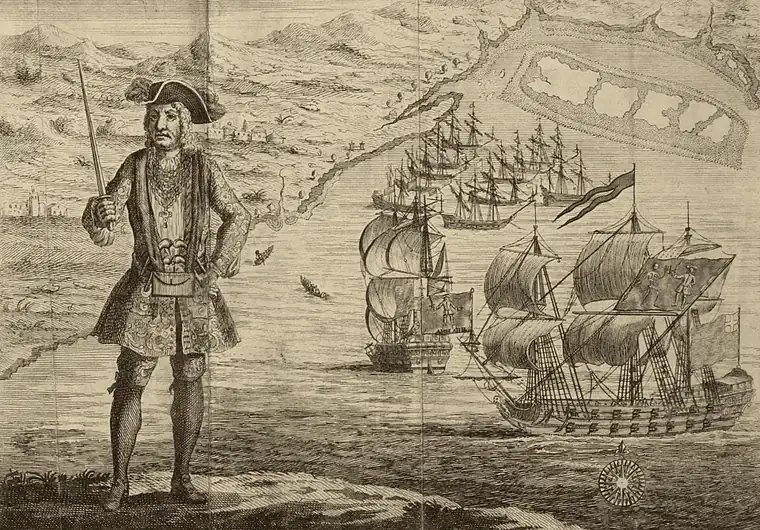
Much of the popular picture comes from one book: A General History of the Pyrates by “Captain Charles Johnson”, first published in 1724. It mixes trial records and news reports with invention, and later novels and films built on it. Treasure maps, walking the plank and parrots are mostly later additions. The timeline lists the key dates.
In the game
Free Nassau is set in 1716–1718, the early Nassau years of the Golden Age, while Nassau was still a pirate haven and the Crown’s pardon was on its way. You play one of five historical captains.
Sources and further reading
- Marcus Rediker, Villains of All Nations: Atlantic Pirates in the Golden Age (Beacon Press, 2004).
- Colin Woodard, The Republic of Pirates (Harcourt, 2007).
- David Cordingly, Under the Black Flag (Random House, 1995).
- Captain Charles Johnson, A General History of the Pyrates (London, 1724). Project Gutenberg.
Category: Events and eras · History