Benjamin Hornigold
The old master of the Flying Gang, and the man who turned on it.
The wiki mixes real history with the invented world of Free Nassau. Historical figures and dates are noted as such; invented characters, places and events belong to the game’s setting.
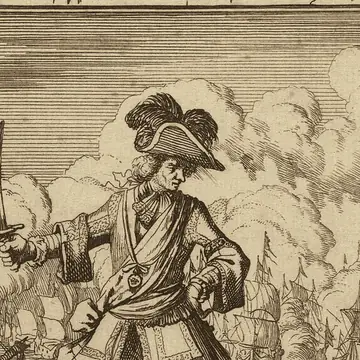
| At a glance | |
|---|---|
| Active | About 1713–1719 |
| Base | Nassau, New Providence |
| Known for | Founding figure of the Bahamas pirate haven; mentor of Edward Teach; pardon-taker and pirate hunter |
| Died | 1719, shipwrecked on a reef |
Origins
Almost nothing certain is known of Benjamin Hornigold’s early life. He was probably English and probably born around 1680, and he likely learned his trade in the long War of the Spanish Succession, when Crown commissions turned hundreds of Caribbean seamen into licensed raiders. The Peace of Utrecht in 1713 ended that work almost overnight. Many former privateersmen were left with skills, small boats and no lawful employer, and New Providence, with its sheltered harbour and its absent government, was the natural place for them to gather.
Hornigold appears in colonial complaints from about 1713, working out of Nassau with open boats called periaguas and then a sloop, taking Spanish and French coasters among the cays of the Bahamas and along the north coast of Cuba. The prizes were modest: cargoes of sugar, rum and dry goods, and sometimes a better vessel. Each success brought more volunteers and larger ships. Within three years he was one of the most important men in the harbour.
The master of the Flying Gang
By 1716 Hornigold commanded a well-armed sloop, remembered in several accounts as the Ranger, and he sailed in company with other captains who would become famous. Samuel Bellamy and Paulsgrave Williams cruised alongside him that year. A young seaman named Edward Teach served under him, rose to command a sloop of his own, and learned his trade in Hornigold’s company before becoming Blackbeard. This loose fraternity of Nassau captains is often called the Flying Gang, and Hornigold is usually counted as its senior figure.
He had one firm rule, and it cost him. Hornigold is said to have refused to attack English ships, holding to the idea that he was still, in some sense, at war only with England’s enemies. Many of his crew saw no reason to pass up a rich English merchantman. In late 1717 they put the question to a vote, as pirate articles allowed, and elected another commander. Hornigold left with the men who stayed loyal to him and returned to Nassau.
The pardon
He came home to news that would reshape the port. King George I’s proclamation of September 1717 offered a pardon to any pirate who surrendered before a deadline. For an older captain who had kept his distance from English shipping, the offer looked like a road back to respectability. Hornigold accepted it in the first months of 1718, as did Henry Jennings, Josiah Burgess and many others. Their decision split Nassau between those who wanted a clean slate and hard-liners such as Charles Vane who refused any king’s paper. See The King’s Pardon of 1717.
Hunter of pirates
When Woodes Rogers arrived as Royal Governor in July 1718, he needed men who knew the islands and the pirates’ habits. Hornigold was the obvious choice. Rogers commissioned him to hunt those who had broken the pardon. He chased Vane without success, but he did bring in a group of men who had returned to piracy within weeks of taking the pardon. They were tried in Nassau, and eight of them were hanged on the waterfront in December 1718. It was a brutal demonstration that the old freedoms were over, and it was carried out in part by the man who had done most to create them.
Death
Hornigold did not long survive his new career. In 1719, on a voyage away from New Providence, his vessel was driven onto an uncharted reef, most accounts say in a storm, and he was lost with much of his crew. The exact place is uncertain. His story became one of the defining arcs of the era: privateer, pirate, mentor, pardon-taker and hunter, all in less than ten years.
In Free Nassau
Hornigold is the final enemy of the voyage. Act III, The Hunter, ends in a fight against the pardoned veteran sailing under a Crown commission, followed by a captain’s duel. The game imagines him at the height of his second career, with a sturdy ship, a disciplined crew and an intimate knowledge of the Bahamas. See How to Play and Factions & Politics.