Charles Vane
No king’s paper.
The wiki mixes real history with the invented world of Free Nassau. Historical figures and dates are noted as such; invented characters, places and events belong to the game’s setting.
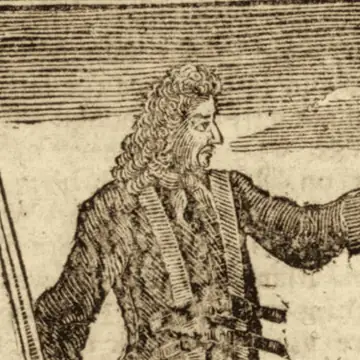
| At a glance | |
|---|---|
| Active | About 1716–1719 |
| Base | Nassau, later the Carolinas and the western Caribbean |
| Known for | Refusing the pardon; the fire-ship escape from Nassau (July 1718) |
| Died | Hanged at Port Royal, Jamaica, March 1721 |
The wreck raiders
Charles Vane first appears in the record in 1716, as one of the men who sailed with Henry Jennings against the Spanish salvage camps on the Florida coast. After the 1715 treasure fleet was wrecked by a hurricane, Spanish divers recovered silver from the shallows and stored it ashore. Jennings’s raid carried off a fortune and helped turn Nassau from a refuge of a few small crews into a magnet for hundreds of seamen. Vane soon had his own command and became one of the most aggressive captains in the harbour.
Against the pardon
When HMS Phoenix brought the King’s pardon to Nassau in February 1718, many captains signed. Vane did not, or at least did not mean to keep to it. He and his crew went back to sea within weeks and treated the offer with open contempt. As older captains such as Hornigold and Jennings drifted toward the Crown, Vane became the leading voice of the companies who wanted no master at all. Contemporary accounts describe him as harsh with captives and quick to violence, but also as a skilled and daring seaman.
The fire ship
In late July 1718 Woodes Rogers arrived off Nassau with warships and a governor’s commission. Vane was in the harbour with a captured French vessel and his own sloop. On the first night he loaded the prize with powder and loose guns, set her alight and sent her drifting toward the naval ships at the harbour mouth. In the confusion the warships cut their cables to escape the flames. The next morning Vane sailed out through the eastern channel past Hog Island, firing guns in defiance and flying his colours, and left the new governor to take possession of a harbour without its most dangerous captain.
Ocracoke and the vote
Vane raided along the Carolina coast through the late summer, and in October 1718 he met Blackbeard at Ocracoke, where the two companies are said to have spent days in celebration. A few weeks later, off the American coast, Vane declined to fight a ship that proved to be a French man-of-war. He judged it too strong. His crew judged him a coward, and under their articles they voted him out of command. The quartermaster, John Rackham, was elected captain in his place, and Vane was set adrift in a small sloop with the men who stayed loyal. See Calico Jack, Anne Bonny & Mary Read.
Shipwreck and the gallows
Vane rebuilt a small command and raided in the western Caribbean, but in early 1719 a hurricane wrecked his sloop on an island in the Bay of Honduras. He survived for some time as a castaway. When a ship finally called, its master is said to have been an old acquaintance who recognised him and refused to carry him. Another vessel took him aboard, but he was recognised again and delivered to Jamaica. He was tried at Spanish Town and hanged at Gallows Point, Port Royal, in March 1721. His body was hung in chains at the harbour entrance as a warning to passing sailors.
In Free Nassau
Charles Vane is a starting captain built around aggressive gunnery: heavy broadsides, burning damage and pressure on the enemy hull from the first turn. In the setting’s wiki he is the voice of the free captains who fear that any rules for Nassau will become another government. See Characters and How to Play.