Ship Types of the Pirate Era
Speed over size, and shallow water over all.
The wiki mixes real history with the invented world of Free Nassau. Historical figures and dates are noted as such; invented characters, places and events belong to the game’s setting.
What pirates wanted in a ship
A pirate vessel had a different job from a merchant ship or a warship. It did not need a large hold, and it did not need to stand in a line of battle. It needed to be fast enough to catch a merchantman and to run from a warship, handy enough to work through narrow channels, and shallow enough to hide where heavier ships could not follow. It also needed space for a large crew, because pirates won most fights by frightening their victims into surrender or by boarding them, not by long gunnery duels. These needs explain why the Caribbean pirates of 1715–1725 favoured small, fast craft, and why a crew that captured a fine ship often refitted her rather than keeping her as she was.
Periagua
The periagua (also pettiagua or pirogue) was a large open boat, sometimes made from a hollowed log and sometimes planked, driven by oars and one or two simple sails. It carried a dozen or more men and could move among the cays and over the shallow banks of the Bahamas with ease. Many pirate careers began in periaguas, taking coasting vessels and fishing boats until the crew could capture something bigger. Hornigold began this way around 1713.
Sloop
The sloop was the workhorse of the Caribbean and the most common pirate vessel. A single mast carried a large fore-and-aft mainsail and headsails set on a long bowsprit, letting the sloop sail closer to the wind than square-rigged ships. Sloops built in Bermuda and Jamaica from local cedar were especially prized for speed. A pirate sloop might mount anywhere from a few to a dozen carriage guns plus swivels on the rails, and carry many more men than a merchant sloop of the same size. Its shallow draught suited the banks around New Providence perfectly.
Brig and brigantine
Brigs and brigantines had two masts. A brig was square-rigged on both; a brigantine carried square sails on the foremast and a fore-and-aft mainsail on the mainmast, combining some of the sloop’s handiness with greater size and carrying power. They were common merchant vessels in Atlantic trade, and pirates who took one gained room for more guns, stores and crew.
Snow
The snow was a two-masted square-rigger closely related to the brig. Its distinguishing feature was a small extra mast, the trysail mast, stepped just behind the mainmast, which carried a fore-and-aft sail. Snows were often slightly larger than brigs and were widely used by Dutch, English and French merchants. A captured snow could make a solid, roomy pirate ship, though not as quick as a good sloop.
Schooner
The schooner, with two masts both rigged fore-and-aft, was only beginning to appear in this period, mainly in New England. It would become one of the great American vessel types later in the century, but in 1717 it was still a novelty in the Caribbean.
Ships, frigates and men-of-war
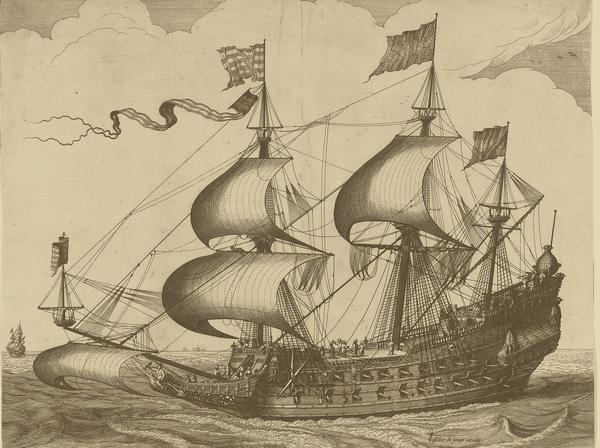
A “ship” in the strict sense had three square-rigged masts. Large merchantmen, slavers and warships were ship-rigged. The most powerful pirate flagships of the era were captured ship-rigged vessels: Blackbeard’s Queen Anne’s Revenge was a former French slaver, and Bellamy’s Whydah a former English slave ship. Such ships carried many guns and men but drew more water and needed regular careening to stay fast. Royal Navy frigates and the Spanish guarda costas were the professional opponents; a well-handled man-of-war could outgun any pirate, but there were never enough of them.
Careening
In tropical waters a hull quickly fouled with weed and was attacked by shipworm, and a foul bottom could cost a ship much of her speed. Crews regularly careened their vessels: running them ashore on a sheltered beach, heeling them over, scraping the hull and paying it with tar, tallow or sulphur. Careening left a ship helpless for days, so quiet, hidden coves were valuable. See the Period Glossary for more ship terms.
In Free Nassau
Your voyage starts in a periagua, and the shipwright lets you trade up through a sloop, brigantine and snow to a frigate. Heavier hulls hit harder and take more punishment, but they gain less Block from Sail cards, so the fast, light ships the real pirates loved still have an edge. See How to Play and Ships, Stores & Crew.