Stede Bonnet
History · sources at the end · the game’s fiction is kept separately
He was a rich man with a plantation and a family, and in 1717 he paid for his own pirate ship.
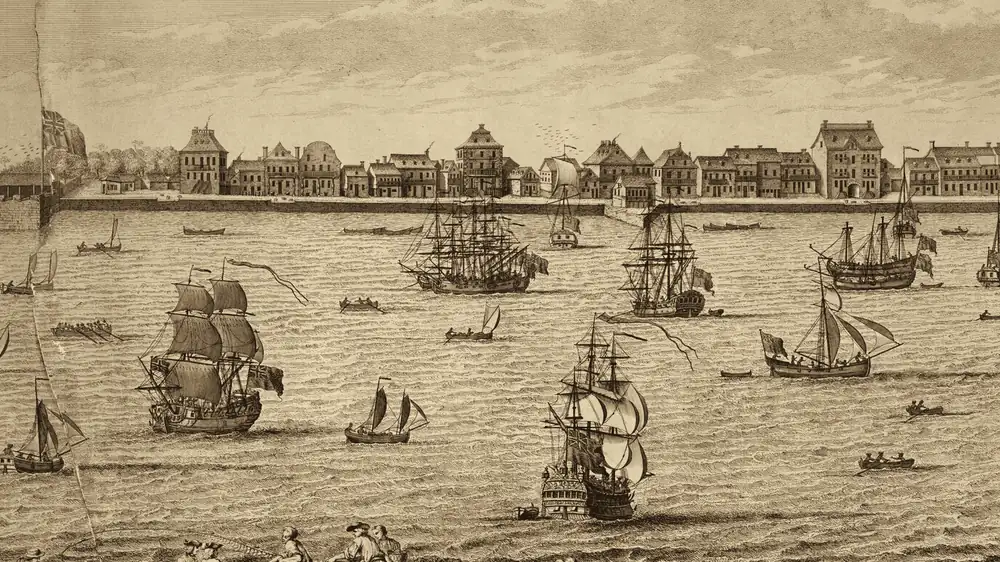
| Background | Landowner and militia major from Barbados, born about 1688 |
| Active | 1717–1718 |
| Ships | Revenge, renamed Royal James in 1718 |
| Known for | Buying his own pirate sloop; his partnership with Blackbeard |
| Fate | Taken at the Cape Fear River in September 1718; hanged at Charles Town, 10 December 1718 |
A planter goes to sea
Most pirates of the 1710s were sailors who had nothing to lose. Stede Bonnet had a great deal. He was born in Barbados around 1688, inherited a sugar estate of some four hundred acres near Bridgetown as a boy, married in 1709 and had young children. He held the rank of major in the island militia. Nobody knows for certain why he left all that. The General History of the Pyrates blamed “a disorder in his mind” and hinted at an unhappy marriage.
In the spring of 1717 he had a sloop built, armed her with ten guns and named her the Revenge. That alone made him unusual. Pirates normally stole their first ship. Bonnet bought his, and he paid his crew of seventy or so wages rather than shares. He knew almost nothing about the sea and depended on his officers to sail her. He slipped out of Carlisle Bay at night and headed for the American coast.
Under Blackbeard’s wing
Bonnet took several prizes off Virginia and the Carolinas that summer. Heading for Nassau, he ran into a Spanish warship. The Revenge was badly damaged, Bonnet was seriously wounded and many of his men were killed or wounded. At Nassau he met Benjamin Hornigold and Edward Teach. Teach took effective command of the Revenge while Bonnet kept to his cabin. A merchant captain taken that autumn described Bonnet walking the deck in his nightclothes, still weak from his wounds and with no command at all.
The two sailed together into the winter of 1717–18. When Teach took the French slave ship La Concorde in November 1717 and made her the Queen Anne’s Revenge, Bonnet got his sloop back, but not for long. In the spring of 1718, after he failed to take a large merchantman off Honduras, his crew went over to Teach. Bonnet stayed aboard the Queen Anne’s Revenge as a sort of guest. He was aboard when Teach blockaded Charles Town in May 1718.
The pardon and the alias
In June 1718 Teach’s flagship ran aground at Topsail Inlet in North Carolina and was lost. Bonnet went to Bath and took the King’s pardon from Governor Charles Eden, with clearance to sail for St Thomas and seek a privateer’s commission against Spain. While he was away, Teach stripped the remaining vessels and left with the best of the plunder and a small crew. Bonnet rescued men Teach had marooned on a sandbar, chased him and failed to catch him.
He then went back to piracy while trying to keep his pardon. He called himself “Captain Thomas” and renamed the Revenge the Royal James. For a while he pretended to trade with the ships he robbed. By July he had dropped the pretence and was taking ships in Delaware Bay.
Cape Fear and Charles Town
In August he put into the Cape Fear River to repair the leaking sloop. South Carolina sent Colonel William Rhett with two armed sloops. On 27 September 1718 the two sides fought for some five or six hours, with all three sloops aground on the shoals and firing at close range. When the rising tide floated Rhett’s sloops first, Bonnet’s men made him surrender.
At Charles Town Bonnet escaped in late October and was retaken on Sullivan’s Island. His crew were tried before Judge Nicholas Trott, and most of them were hanged on 8 November. Bonnet was tried separately and condemned. He wrote to Governor Robert Johnson begging for his life, and many in the town pitied him, but Johnson would not reprieve him. He was hanged at White Point on 10 December 1718, eighteen days after Teach was killed at Ocracoke and two days before the hangings at Nassau.
Legend and record
Later writers made Bonnet one of the few pirates who made prisoners walk the plank. The detailed record of his trial says nothing about it, and historians treat the story as a later invention. The trial record, printed in London in 1719, is the best source for his last cruise. It also shows his men saying his quartermaster held more real power aboard than he did.
In the game
Bonnet is not a playable captain, but his story runs alongside Blackbeard’s, and the choice he failed at is the one every run asks of you: keep raiding, or quit while you can. See the Blackbeard page and the King’s Pardon.
Sources and further reading
- The Tryals of Major Stede Bonnet, and Other Pirates (London, 1719), the printed record of the Charles Town trials.
- Captain Charles Johnson, A General History of the Pyrates (1724), chapter on Major Stede Bonnet.
- Lindley S. Butler, Pirates, Privateers, and Rebel Raiders of the Carolina Coast (2000).
- Hugh F. Rankin, The Pirates of Colonial North Carolina (1960).
- Robert C. Ritchie, “Bonnet, Stede”, Oxford Dictionary of National Biography (2008).
- Colin Woodard, The Republic of Pirates (2007).