The Nassau Hangings, December 1718
History · sources at the end · the game’s fiction is kept separately
Five months after Woodes Rogers landed, he showed Nassau what breaking the pardon would cost.
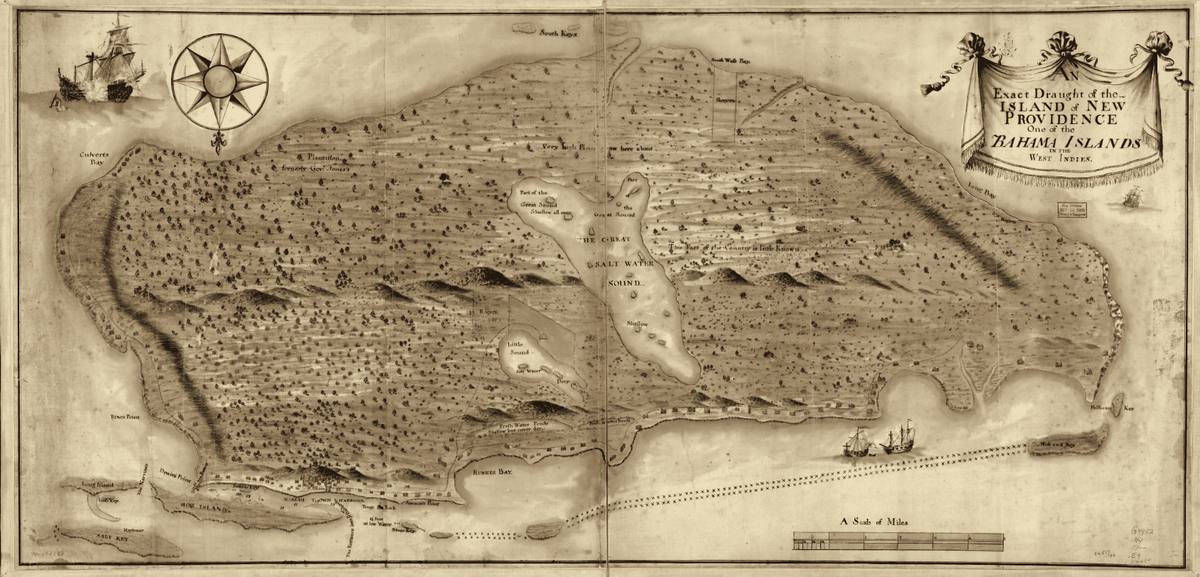
| Mutiny | 6 October 1718, at Green Key, a cay about seventy miles south of New Providence |
| Captured by | Benjamin Hornigold and John Cockram |
| Trial | 9–10 December 1718, in the guard room of the fort at Nassau |
| Executions | Eight men hanged on 12 December 1718; one reprieved at the gallows |
A trading voyage
Woodes Rogers arrived as governor in July 1718. Hundreds of men had taken the King’s pardon, but the colony was poor, and many of them had no work. That autumn Rogers sent three vessels south on a trading voyage: the schooner Batchelor’s Adventure and the sloops Mary and Lancaster. Several of the hands were pardoned pirates. One of them, John Augur, an older seaman who had commanded vessels out of Jamaica, was trusted with the Mary.
The mutiny at Green Key
On 6 October the three vessels lay at anchor at Green Key. That night Phineas Bunce and Dennis Macarty seized the schooner. Bunce told Captain Greenaway, master of one of the other vessels, that he was a prisoner, and Macarty held a pistol to his chest. Most of the Mary’s crew joined them. Five men who refused were put ashore on the cay. The mutineers plundered the cargoes and sailed off, warning Greenaway to stay put. He sailed for help the next morning, was caught, and hid on the island while they scuttled his vessel.
The new pirates did not last long. They attacked vessels at anchor that turned out to be Spanish privateers, and the fight went badly for them. Bunce was badly wounded. Rogers sent Hornigold and John Cockram, both pardoned pirates themselves, to hunt them down. They brought back thirteen men, three of whom died of their wounds; Bunce did not live to be tried.
The trial
Rogers had to improvise. He held a court of Admiralty in the guard room of the fort on 9 and 10 December 1718, sitting as president with William Fairfax as judge and other officers and residents beside him. Ten men stood at the bar: John Augur, William Cunningham, Dennis Macarty, William Dowling, William Lewis, Thomas Morris, George Bendall, William Ling, George Rounsivell and John Hipps. The five marooned sailors and Greenaway gave evidence. Hipps, Greenaway’s boatswain, called witnesses to show he had been forced to join under threat of being marooned. The court convicted the other nine and put off judgment on him.
On the ramparts
The executions took place on the morning of 12 December. The condemned men were led up to the ramparts of the fort for prayers and psalms, then down a ladder to a gallows built at the foot of the walls, under a black flag. They stood on a stage resting on barrels. Augur, unwashed and in his old clothes, drank a small glass of wine to the success of the islands and the governor. Macarty wore blue ribbons like a prizefighter and kicked his shoes over the parapet, saying he had promised not to die with them on. Thomas Morris, twenty-two, wore red ribbons and said he wished he had been a greater plague to the islands.
At the last moment Rogers had George Rounsivell untied and taken off the stage. He was a young man from Dorset, the county Rogers came from, and Rogers later asked London to pardon him. Then the barrels were pulled away. Eight men were hanged. Some later books give nine, which mixes up the convictions with the executions; the record supports eight.
Why it mattered
The hangings were the turning point of Rogers’s governorship. The pardon had been mercy; this was the other half of the bargain, carried out in front of the people who had taken it. The men who caught the mutineers were former pirates, and the crowd watching were former pirates too. Nassau did not rise to save them. The General History of the Pyrates printed the minutes of the trial, which is why the day is so well known. In the same weeks Stede Bonnet was hanged at Charles Town and Blackbeard was killed at Ocracoke.
In the game
The hangings stand behind Act III, The Hunter: the pardoned veteran Hornigold, who caught the Green Key mutineers, is the final enemy of every voyage. The “Forced Man” event, where a carpenter begs for a paper swearing he was pressed, echoes John Hipps’s defence. See Benjamin Hornigold and the Timeline.
Sources and further reading
- Trial and condemnation of ten persons for piracy at New Providence, December 1718, The National Archives (UK), CO 23/1, no. 18; abstracted in Calendar of State Papers, Colonial: America and West Indies, vol. 31, no. 475.
- Woodes Rogers to James Craggs, 24 December 1718, Calendar of State Papers, Colonial, vol. 30, no. 807.
- Captain Charles Johnson, A General History of the Pyrates, vol. 2 (1728), which prints the minutes of the trial.
- David Cordingly, Pirate Hunter of the Caribbean: The Adventurous Life of Captain Woodes Rogers (2011), chapter “Hanged on the Waterfront”.
- Colin Woodard, The Republic of Pirates (2007).
Category: Events and eras · History