The Charleston Blockade (1718)
History · sources at the end · the game’s fiction is kept separately
Blackbeard held a whole colonial capital to ransom, and what he asked for was medicine.
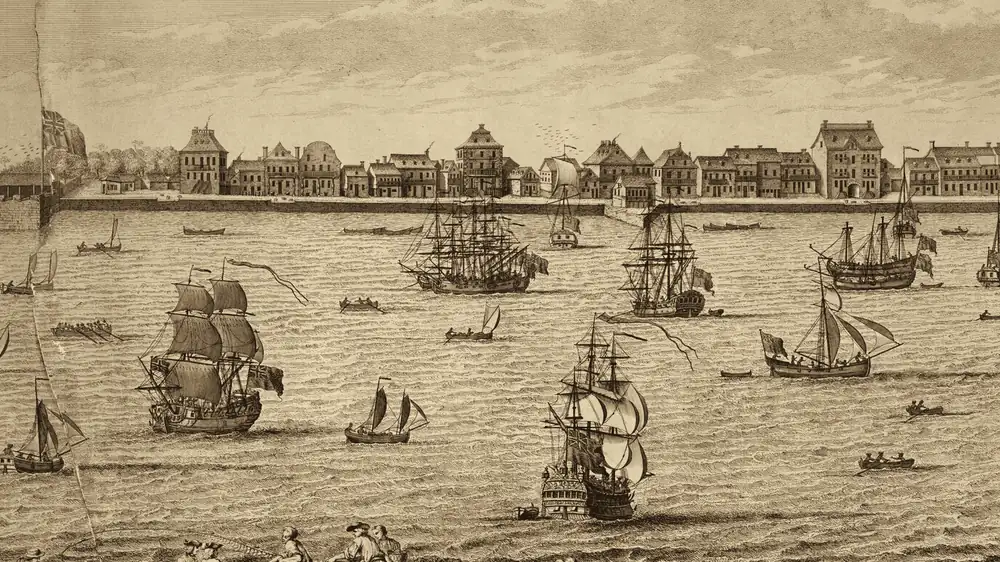
| Date | About 22–30 May 1718 (Old Style) |
| Place | Off the bar of Charles Town (now Charleston), South Carolina |
| Pirate force | Queen Anne’s Revenge and three sloops, some 300–400 men |
| Ransom | A chest of medicines worth about £300–400 |
The fleet arrives
In May 1718 Edward Teach, Blackbeard, came north from the Caribbean with a fleet of four vessels led by the Queen Anne’s Revenge. Stede Bonnet, by then more Teach’s guest than a captain, was aboard. They anchored off the bar of Charles Town, the capital of South Carolina and one of the richest ports in British America.
The port had no warship to protect it. Over the next few days the pirates stopped every vessel going in or out. They took around nine ships. One, the Crowley, bound for London, carried passengers including Samuel Wragg, a member of the colony’s governing council, and his young son.
The demand
Teach held a council of his captains, then sent a party ashore under a man Johnson calls Mr. Marks, with some pirates. Their message to Governor Robert Johnson was simple: send a chest of medicines, or the prisoners’ heads would be sent to the governor and the captured ships burned.
The colony gave in, though the medicine took time. The pirates on shore walked the town openly while the chest was gathered, and their boat was delayed by bad weather. The prisoners, believing they would be killed, persuaded Teach to wait. In the end the chest, valued at between £300 and £400, was delivered. The pirates released the hostages and ships, after stripping them of money and goods. Wragg alone was said to have lost some £1,500 in coin.
Why medicine?
Nobody recorded Teach’s reasons. Historians have suggested that many of his men were sick, perhaps with fevers or venereal disease, and medicine was hard to buy anywhere pirates could go. The demand fits a wider pattern: pirates took what kept a ship working, from surgeons and medicine to rigging and powder.
Aftermath
Teach sailed north. Within about a week the Queen Anne’s Revenge was aground at Topsail Inlet, and Teach broke up his company. South Carolina did not forget. Later in 1718 Colonel William Rhett captured Stede Bonnet in the Cape Fear River, and Bonnet and dozens of his men were hanged at Charles Town. Governor Johnson himself led ships that defeated the pirate Richard Worley the same autumn. The blockade convinced colonial leaders that the Crown and colonies had to act together, and helped lead Virginia to send the force that killed Teach at Ocracoke in November.
The blockade is one of the best-documented acts of the Golden Age, described in Governor Johnson’s letters to London and in trial records, as well as in the General History.
In the game
Medicine matters in the game as well. The surgeon officer, the Infirmary in Nassau and repair supplies are what keep a crew going between fights.
Sources and further reading
- Governor Robert Johnson to the Council of Trade and Plantations, 18 June 1718, Calendar of State Papers, Colonial Series, America and West Indies, vol. 30.
- Captain Charles Johnson, A General History of the Pyrates (London, 1724), chapter on Teach. Project Gutenberg.
- Lindley S. Butler, Pirates, Privateers, and Rebel Raiders of the Carolina Coast (University of North Carolina Press, 2000).
- Colin Woodard, The Republic of Pirates (Harcourt, 2007).
Category: Events and eras · History