Black Sam Bellamy and the Whydah
History · sources at the end · the game’s fiction is kept separately
About a year as a captain, one famous ship, and a wreck that was found again 267 years later.
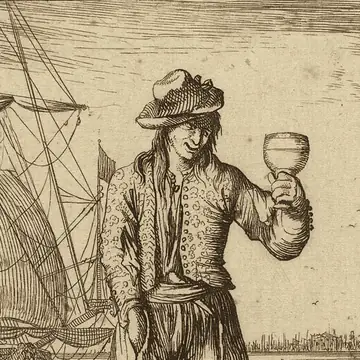
| Born | About 1689, Devon, England |
| Active | 1716–1717 |
| Flagship | Whydah Gally, an English slave ship taken in early 1717 |
| Died | 26–27 April 1717, wrecked off Cape Cod, Massachusetts |
Before the black flag
Samuel Bellamy was probably born in Devon, in the west of England, around 1689. Little is certain about his early life beyond the fact that he went to sea. By 1715 he was in New England. When news spread that the Spanish treasure fleet had been wrecked on the Florida coast that summer, he went south with others hoping to dive or dig for the lost silver. See The 1715 Treasure Fleet. The wrecking camps paid off for very few of them, and by 1716 Bellamy had turned to plain robbery at sea.
With Hornigold, then on his own
In 1716 Bellamy and his partner Paulsgrave Williams cruised alongside Benjamin Hornigold and the Nassau captains. They also crossed paths with Henry Jennings, and at Bahía Honda in Cuba they made off with much of the coin from a French ship Jennings had just taken. Hornigold refused to attack English ships, and his crew did not like that rule. Some time in 1716, before November, the company split. One of Bellamy’s men later testified that Bellamy was “chosen by a great Majority” as captain, while Hornigold left with 26 men in a prize sloop. That was how pirate crews worked: the captain led in a fight, but the company chose him and could replace him. See Pirate Articles & Life at Sea.
The Whydah
In late February 1717, near the Windward Passage between Cuba and Hispaniola, Bellamy chased down the Whydah Gally, a new London ship of around 300 tons. She was a slave ship. She had carried enslaved Africans from the West African coast to Jamaica, and she was sailing home with what that trade had earned: money, sugar, indigo and other goods. Bellamy kept her as his flagship and gave her master, Lawrence Prince, one of the smaller prizes to sail home in. Some of the Africans on board when she was taken may have joined the pirates; the record isn’t clear.
The Whydah was fast and well armed, and Bellamy took more prizes on his way up the American coast that spring. His company grew to well over a hundred men.
The wreck
On 26 April 1717, off Cape Cod, Bellamy took more ships and put prize crews aboard them. That night a storm drove the fleet onto the coast. The Whydah hit a sandbar off what is now Wellfleet around midnight and broke apart. Of about 145 people aboard, only two reached the beach alive: the carpenter, Thomas Davis, and the pilot, John Julian. Bellamy drowned with the rest. He was probably about 28.
Seven of his men, put aboard a captured wine pink called the Mary Anne, were also driven ashore and were arrested at Eastham. They and Thomas Davis were tried at Boston in October 1717. Davis and one other man were acquitted, and six were hanged on 15 November 1717. The colony sent Captain Cyprian Southack to salvage the wreck, but local people had stripped the beach before he arrived, and he recovered little.
Found again
In 1984 an explorer named Barry Clifford found the wreck off Wellfleet. In 1985 his team raised the ship’s bell, cast with the words THE WHYDAH GALLY 1716. It was the first pirate wreck of the period to be identified beyond doubt. Since then divers have brought up coins, gold, weapons, and many everyday objects, including West African gold jewellery from the ship’s slaving voyage. Much of it is shown at the Whydah Pirate Museum in Massachusetts.
The legend
Bellamy is often called the Prince of Pirates, and the 1724 General History of the Pyrates gives him a long speech attacking rich men who “rob the poor under the cover of law.” Nobody wrote that speech down at the time. It is best read as the author’s invention. Lists that rank him the “richest pirate ever” are modern guesswork too.
In the game
Bellamy is a playable captain. His passive, Prince of Pirates, starts him with Henry Jennings as Quartermaster for extra silver, and officers cost him less to hire. See the Bellamy captain guide.
Sources and further reading
- Colin Woodard, The Republic of Pirates (2007), chapters on Bellamy, Hornigold and the Whydah.
- Barry Clifford with Paul Perry, Expedition Whydah (1999).
- “Bell Confirms That Salvors Found Pirate Ship of Legend”, The New York Times, 1 November 1985.
- The Trials of Eight Persons Indited for Piracy (Boston, 1718), the printed record of the Boston trial.
- Captain Charles Johnson, A General History of the Pyrates (1724; Bellamy’s chapter is in the 1728 second volume).