Paulsgrave Williams
History · sources at the end · the game’s fiction is kept separately
He came from one of Rhode Island’s respectable families, and he went to sea to dive for Spanish silver.
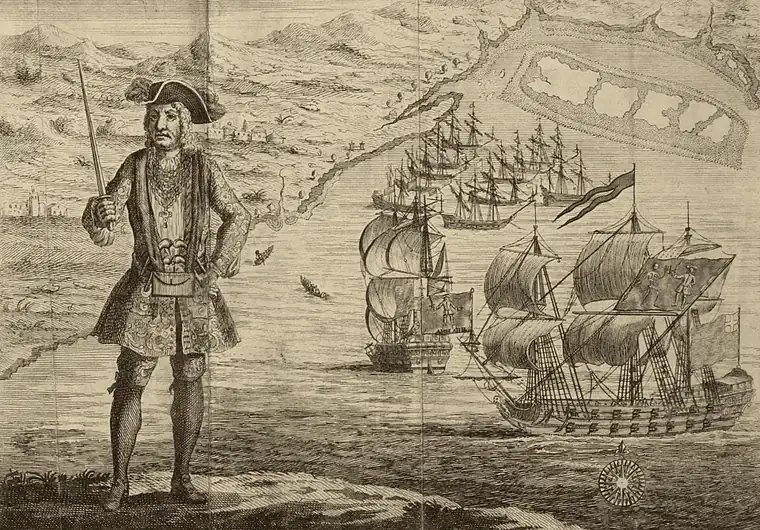
| Background | Silversmith of Newport, Rhode Island; born about 1675–78 |
| Active | 1716–1720s |
| Ship | Marianne (sometimes Mary Anne), a sloop of about ten guns |
| Known for | Sailing as partner to Black Sam Bellamy |
| Fate | Unknown |
An unlikely pirate
Paulsgrave Williams (his first name is also spelled Palsgrave or Palgrave) did not fit the usual picture. His father, John Williams, had been attorney general of Rhode Island. His mother’s family were among the first settlers of Block Island. He worked as a silversmith, had a wife and children, and was close to forty when, around 1715, he threw in his lot with a young sailor named Samuel Bellamy. Their plan was to dive on the wrecks of the 1715 Spanish treasure fleet off Florida.
From wreck-diving to piracy
The wrecks gave them little, and in 1716 they turned to piracy with small boats and a few dozen men. In April 1716, at Bahía Honda on the coast of Cuba, Henry Jennings had taken a French ship full of coin. While Jennings was away chasing another prize, Bellamy and Williams made off with a large share of it. That made Jennings an enemy, and drew them toward Benjamin Hornigold, who was no friend of his. They cruised with Hornigold and the French captain Olivier Levasseur. When Hornigold’s crew voted him out for refusing to attack English ships, they chose Bellamy as captain of the Marianne, and Williams served as his quartermaster.
The Marianne and the Whydah
Near the Virgin Islands at the end of 1716, Bellamy moved into a captured ship, the Sultana, and Williams took command of the Marianne. In February 1717 the two chased down the slave ship Whydah, and Bellamy made her his flagship. They worked north up the American coast that spring. Williams parted company to visit family on Block Island, and they arranged to meet again off Maine.
The meeting never happened. On the night of 26 April 1717 the Whydah was wrecked in a storm off Cape Cod, and Bellamy died with almost all his crew. Williams learned of it in Maine. The General History of the Pyrates wrongly says he was lost too, probably because Bellamy’s company had another vessel called the Mary Anne, which was also wrecked that night. Williams sailed south again and had to put down a rising among men he had forced to serve.
After Bellamy
Back in the Bahamas, Williams is said to have sold the worn-out Marianne and taken the King’s pardon along with many others in 1718. If he did, it did not hold. By about 1720 he was at sea again, under William Moody and then as quartermaster to his old companion Levasseur off West Africa. One account notes that he resented no longer being in command, and that prisoners were advised to keep calling him “Captain”. After the early 1720s he disappears from the record. Stories that he retired with a new family are not supported by period sources.
In the game
Williams has no part of his own in the game, but Bellamy’s captain story begins with him: the two turned pirate together in 1716 and sailed in company with Hornigold. See Black Sam Bellamy and the Whydah and the Bellamy captain guide.
Sources and further reading
- Captain Charles Johnson, A General History of the Pyrates (1724), on Bellamy and Williams (it wrongly reports Williams lost in the 1717 storm).
- Colin Woodard, The Republic of Pirates (2007), on Bellamy, Williams and Nassau in 1716–18.
- Barry Clifford and Paul Perry, Expedition Whydah (1999).
- Edward Theophilus Fox, “Piratical Schemes and Contracts: Pirate Articles and Their Society 1660–1730” (PhD thesis, University of Exeter, 2013), on Williams’s later career.
- Kenneth J. Kinkor, “Black Men under the Black Flag”, in C. R. Pennell, ed., Bandits at Sea (2001), on the Bellamy company.