The Jolly Roger and Pirate Flags
History · sources at the end · the game’s fiction is kept separately
A pirate flag was a threat in cloth: surrender now, or expect no mercy.
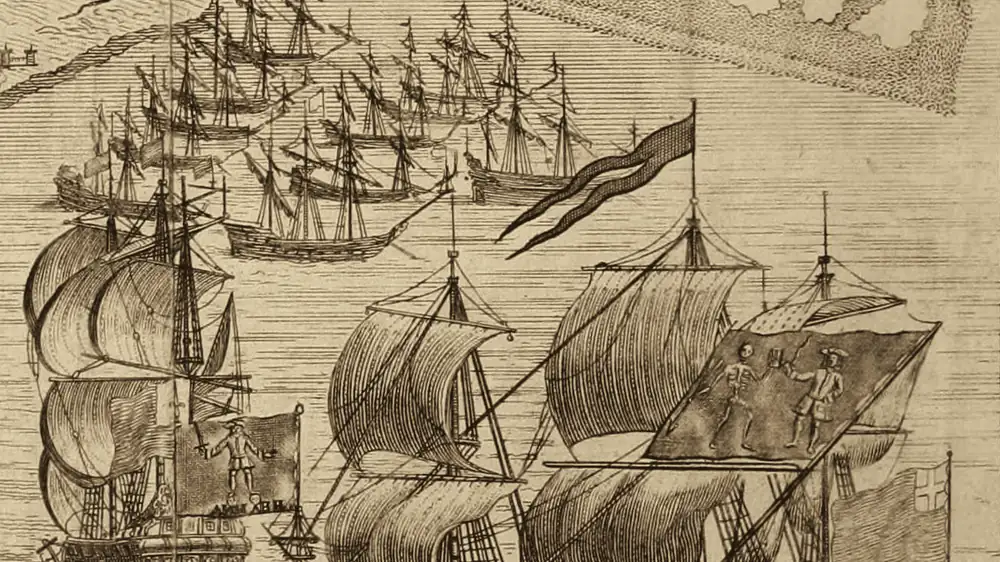
| Earliest record | 1700: a black flag with skull, crossbones and hourglass, flown by Emanuel Wynne |
| Common in | About 1716–1726 |
| Black flag | Usually meant quarter would be given if the target surrendered |
| Red flag | Usually meant no quarter |
What the flag was for
Pirates did not want to fight. A battle could damage the prize, kill the crew and use up powder. Most merchant ships carried small crews and few guns, and a pirate ship crowded with men could usually take them by fear alone. The flag delivered the message. It told a merchant captain who he was dealing with, and that surrender would be treated better than resistance. Many accounts describe pirates first flying a false or national flag to get close, then hoisting their own at the last moment.
Black and red
Period sources describe two colours. A black flag, often with a design, was the usual pirate colour. A red or “bloody” flag was older. It had long signalled a fight to the death and no quarter. Some crews flew both: the black first, and the red if a target resisted. Captured sailors and colonial officials reported both in their depositions.
Skulls, bones and hourglasses
The earliest recorded skull-and-bones flag is from 1700, when the French pirate Emanuel Wynne was described flying a black flag with crossbones, a death’s head and an hourglass. These were the ordinary symbols of death on gravestones of the time. An hourglass meant time running out. Darts, spears, bleeding hearts, raised glasses and cutlasses appear in other descriptions.
The best-documented flags of the age belong to Bartholomew Roberts. One showed Roberts and a skeleton holding an hourglass between them. Another showed him standing on two skulls marked “ABH” and “AMH”, for “A Barbadian’s Head” and “A Martinican’s Head”. Several captains used a skull and crossbones on black, and a flag of that kind recovered with Roberts’s crew was described at their trial.
The name
The term “Jolly Roger” is recorded in the early 1720s, both in Johnson’s General History (1724) and in captives’ accounts. Its origin is unknown. Popular theories include a corruption of the French joli rouge (“pretty red”) or a link to “Old Roger”, a slang name for the Devil. Neither has firm evidence behind it.
Famous flags that are not period
Many flags now sold as the flags of Blackbeard, Calico Jack Rackham, Edward England and others first appear in books and magazines of the nineteenth and twentieth centuries. The well-known “Blackbeard” flag, a horned skeleton spearing a bleeding heart, has no contemporary source. The skull over crossed swords linked to Rackham is likewise a modern attribution. Contemporary descriptions of Teach’s flag mention only a black flag with a death’s head.
After the Golden Age
When the pirates were tried, their flags could be used as evidence. A flag was hung over some hangings to shame the condemned. Later the skull and crossbones moved into fiction, the navies of the world, poison labels and sport. The Royal Navy’s submarines still fly a Jolly Roger after a successful patrol.
In the game
Each captain in Free Nassau sails under a pirate flag, and enemy ships fly the colours of merchants, navies and rival pirates. See Factions & Politics.
Sources and further reading
- David Cordingly, Under the Black Flag (Random House, 1995), chapter “The Jolly Roger”.
- E. T. Fox, “Jacobitism and the Golden Age of Piracy”, International Journal of Maritime History 22 (2010).
- Marcus Rediker, Villains of All Nations (Beacon Press, 2004), chapter “The Jolly Roger”.
- Captain Charles Johnson, A General History of the Pyrates (London, 1724). Project Gutenberg.
Category: Life and customs · History