What Pirates Actually Wore
History · sources at the end · the game’s fiction is kept separately
Mostly what any sailor wore. Then, after a good prize, whatever they could take.
| Everyday | Short jacket, shirt, cap or hat, loose canvas trousers or breeches |
| Plunder | Clothes were loot; Roberts’s articles gave boarders “a Shift of Cloaths” |
| Best-dressed | Bartholomew Roberts, in crimson damask, 1722 |
| Myths | Eye patches, earrings and skull-badged hats are mostly later illustration |
Working clothes
Pirates were sailors first, mostly from merchant ships and the navy, and they dressed like sailors. Around 1700 that meant clothes for wet, tar and rope work: a short jacket, a linen or checked shirt, a cap or a cheap hat, and loose trousers or wide breeches cut short of the ankle, so they stayed out of the way aloft. Ready-made clothes sold to seamen were called slops. None of it lasted long in the tropics.
Clothes as plunder
Since clothes wore out fast and were worth money, they were loot like anything else. Roberts’s articles explain that men were called by list to board prizes in turn, because “over and above their proper Share” they were “allowed a Shift of Cloaths.” At the trial of his crew in 1722, Harry Glasby said the same: each man going aboard a prize got a change of clothes, “the best they can find.” Johnson says volunteers for a boat attack were promised “a Shift of Cloaths, from Head to Foot, out of the Prize.”
The victims noticed. Captain James Macrae, whose ship the Cassandra was taken by Edward England’s men in 1720, complained that they gave him a wreck of a ship and bales of the company’s cloth, “tho’ they would not give me a Rag of my Cloathes.”
The captain in crimson
Some captains dressed the part. Johnson’s description of Bartholomew Roberts at his last fight, off Cape Lopez in February 1722, is the source of half the pirate costumes ever made: “dressed in a rich crimson Damask Wastcoat and Breeches, a red Feather in his Hat, a Gold Chain round his Neck, with a Diamond Cross hanging to it, a Sword in his Hand, and two Pair of Pistols hanging at the End of a Silk Sling.” Before the fight was over he was dead, killed by grapeshot.
Blackbeard, in Johnson’s account, went for theatre rather than finery: a long black beard twisted into little tails with ribbons, a sling of pistols, and lighted matches tucked under his hat so the smoke curled round his face. How much of that is reporting and how much is Johnson’s flair is anyone’s guess.
Bonny and Read
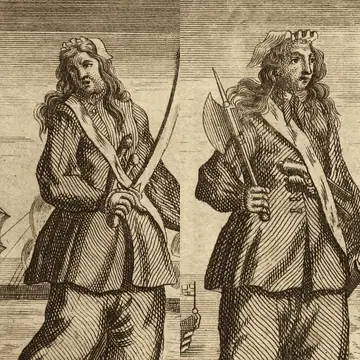
The best eyewitness description of pirate dress comes from the 1721 trial of Anne Bonny and Mary Read in Jamaica. Dorothy Thomas, whose canoe Rackham’s sloop had robbed, testified that the two women “wore Mens Jackets, and long Trouzers, and Handkerchiefs tied about their Heads,” each with a machete and pistol in her hands. Two Frenchmen said they wore men’s clothes when chasing or attacking a ship, and women’s clothes the rest of the time. It is a practical detail and it sounds right.
What they didn’t wear
There is nothing in the records tying eye patches or gold earrings to pirates in particular. The three-cornered cocked hat was ordinary wear for gentlemen and officers at the time, so a captain may well have had one, but the skull and crossbones on the front belongs to the stage. For more of the same, see Pirate Myths.
In the game
Free Nassau’s captain portraits use these same 1724 engravings, Bonny and Read included, sash and axe and all. See the Bonny & Read captain guide or set sail.
Sources and further reading
- Captain Charles Johnson, A General History of the Pyrates (London, 1724). Project Gutenberg.
- The Tryals of Captain John Rackam, and Other Pirates (Jamaica, 1721).
- David Cordingly, Under the Black Flag (Random House, 1995).
- Marcus Rediker, Between the Devil and the Deep Blue Sea (Cambridge, 1987).
Category: Life and customs · History