Olivier Levasseur (La Buse)
History · sources at the end · the game’s fiction is kept separately
His legend says he threw a cipher to the crowd before he hanged.
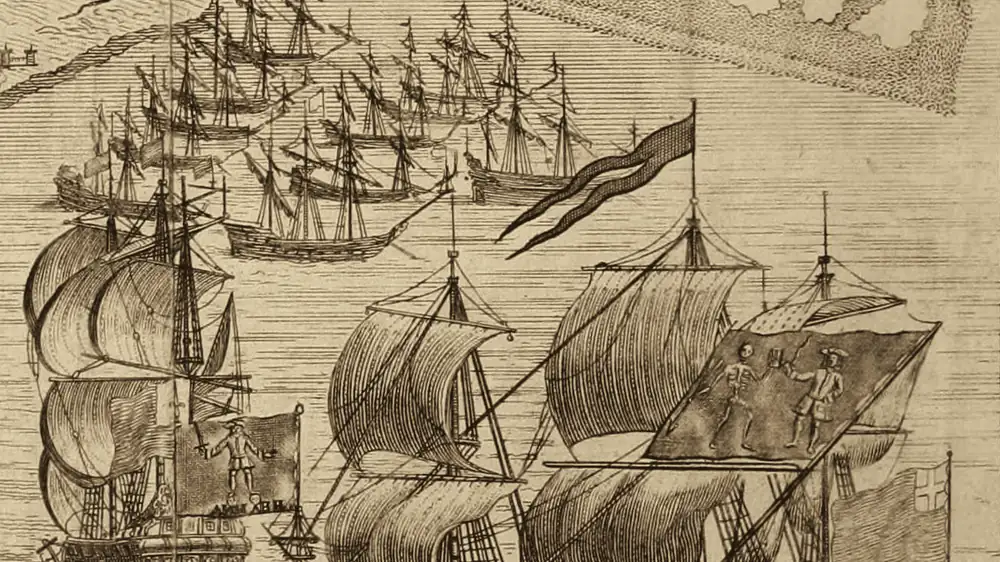
| Born | Calais, France, about 1690 |
| Nickname | La Buse (The Buzzard) |
| Active | About 1716–1724 |
| Died | 7 July 1730, hanged at Saint-Denis, Réunion |
From the Caribbean
Levasseur probably began as a French privateer in the War of the Spanish Succession. In 1716 he was cruising the Caribbean with Benjamin Hornigold and Samuel Bellamy, and he was part of the loose community of the Republic of Pirates. When the pardon came he moved on.
West Africa
By 1719 he was raiding the West African coast. With Thomas Cocklyn and Howell Davis he joined in the attack on the Royal African Company’s fort at Sierra Leone. The crews quarrelled and split up. Levasseur later rounded the Cape of Good Hope for the Indian Ocean.
The richest prize
In the Indian Ocean Levasseur sailed with John Taylor and, for a time, Edward England. After England was marooned, Taylor and Levasseur went on in the captured Cassandra. In April 1721 at Saint-Denis on Réunion, then called Île Bourbon, they found the Portuguese ship Nossa Senhora do Cabo, damaged by a storm, at anchor. Aboard were the Count of Ericeira, returning from his post as viceroy of Portuguese India, and an enormous treasure in diamonds, gold, silver and church plate. It was one of the richest prizes of the age. The pirates released the viceroy and shared out the treasure, with each man said to have received thousands of pounds and dozens of diamonds.
Capture and death
Afterwards the crews broke up. Taylor sailed to the Caribbean and took a Spanish pardon. Levasseur stayed in the Indian Ocean and probably settled on Madagascar. In 1724 France offered pardons to pirates in the region, but Levasseur did not accept the terms. He was captured about 1729 near Fort Dauphin, taken to Réunion, tried and hanged at Saint-Denis on 7 July 1730.
The cryptogram
A popular legend says that on the scaffold he threw a cryptogram to the crowd and cried: “My treasure to whoever can understand it!” No contemporary record mentions this. The cryptogram that treasure hunters study was published in the 1930s and its origin is unclear. Treasure hunters have dug on the Seychelles and Réunion for decades without success. His grave in the old cemetery of Saint-Paul, Réunion, is a tourist site, though whether it is really his is uncertain.
Life on Madagascar and Réunion
After 1721 the pirates of the Indian Ocean had few safe places left. The French island of Réunion offered pardons from 1724, and many pirates settled there and married local women. Madagascar still had small pirate settlements, but they were shrinking. The English and French navies sent squadrons into the region, and East India Company ships sailed in convoys. Levasseur seems to have worked for a time as a pilot in the bay of Antongil, a sign of how far the old pirate world had shrunk.
In the game
La Buse sailed in the same waters as the Nassau captains of Free Nassau. See The Pirate Round.
Sources and further reading
- Captain Charles Johnson, A General History of the Pyrates (London, 1724). Project Gutenberg.
- Arne Bialuschewski, “Pirates, Slavers, and the Indigenous Population in Madagascar, c. 1690–1715”, International Journal of African Historical Studies 38 (2005).
- Jan Rogoziński, Honor Among Thieves (Stackpole, 2000).
- David Cordingly, Under the Black Flag (Random House, 1995).