Careening: Cleaning a Ship’s Hull
History · sources at the end · the game’s fiction is kept separately
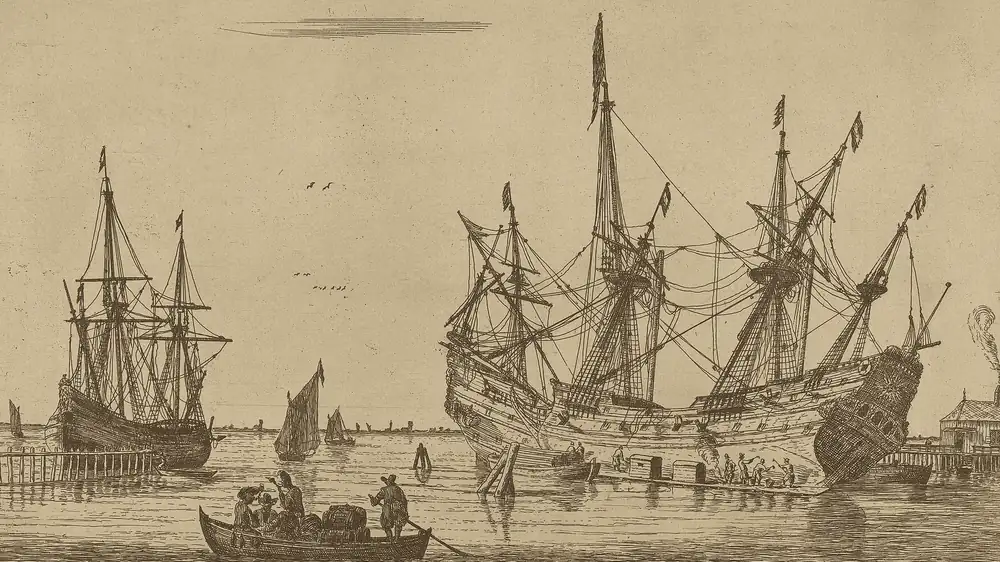
A ship on her side on the beach could not fight or flee.
| Why | Weed, barnacles and shipworm slowed and destroyed hulls |
| How often | Every few months in tropical waters |
| Coatings | Mixtures of tallow, sulphur, tar and pitch |
| Risk | The ship was helpless until refloated |
The problem
A wooden hull in warm seas grew a beard of weed and barnacles within weeks. A foul bottom could cut a ship’s speed sharply, which for a pirate meant prizes escaping and warships catching up. Worse was the shipworm, Teredo navalis, a mollusc that bores tunnels through planking until a hull is like a honeycomb. In the Caribbean a ship could be ruined in a year or two if left untended.
Heaving down
Navies had dry docks. Pirates and most merchantmen used a beach. The crew unloaded guns, stores and ballast, then brought the ship into shallow water at high tide. With tackles run from the masts to trees or anchors ashore, they heaved her over onto one side, exposing half of the bottom. Men scraped off weed and shell, burned it off with torches of reeds, replaced rotten planks, and then paid the clean hull with a hot mixture of tallow, sulphur and tar or pitch, often called “stuff”. Then they righted her and did the other side. The whole job could take one or two weeks.
Where pirates careened
A careening place needed a sheltered beach with a steep enough shore, fresh water, wood, and few visitors. The shallow cays of the Bahamas, the islands off Honduras, the inlets of the Carolinas, and Madagascar’s bays were favourites. Pirate crews often careened together for safety. Blackbeard used the inlets of North Carolina, including Ocracoke. In the Indian Ocean, crews of the Pirate Round careened at Île Sainte-Marie, where shipworm was a constant enemy.
Caught on the beach
Careening was the moment of greatest danger. Guns were ashore, and the ship could not move. Pirate hunters knew this. Johnson tells of several crews surprised while hove down, and of others who lost their ships when a storm struck a careening place. Charles Vane ended his career shipwrecked on a small island in the Bay of Honduras, a common careening ground. In 1718 Stede Bonnet was caught careening in the Cape Fear River, North Carolina, by Colonel William Rhett’s sloops from Charles Town. The battle that followed ended with Bonnet’s surrender and, later, his hanging.
The cure
The Royal Navy experimented with lead sheathing in the late 1600s, but lead corroded the iron fastenings. Copper sheathing, tested on HMS Alarm in 1761 and adopted across the fleet in the 1770s and 1780s, finally solved the problem for navies. Pirates of the Golden Age never had it. Every few months they went back to the beach.
Careening and pirate life
Careening was also a social event. With the ship on her side there was little to do at night but eat, drink and play. Crews hunted turtle and wild hogs, smoked meat on wooden frames (a boucan, from which the buccaneers took their name), and held long, drunken parties on the beach. Captured sailors sometimes escaped during these weeks ashore, and some later testified at pirate trials about what they had seen. The pirate camp at a careening place looked much like the Nassau of 1716: tents, fires, barrels and plunder spread along the shore.
In the game
Careening coves appear on Free Nassau’s sea charts: a chance to repair the hull, at a price in time. See How to Play.
Sources and further reading
- Captain Charles Johnson, A General History of the Pyrates (London, 1724). Project Gutenberg.
- Brian Lavery, The Arming and Fitting of English Ships of War, 1600–1815 (Conway, 1987).
- Randolph Cock, “‘The Finest Invention in the World’: The Royal Navy’s Early Trials of Copper Sheathing, 1708–1770”, Mariner’s Mirror 87 (2001).
- David Cordingly, Under the Black Flag (Random House, 1995).
Category: Ships and seafaring · History
See also
Strategy guides
Coves in the game let you careen, rest or improve a card, one choice per visit. Economy and routes and Officers and ship upgrades help you pick.