Christopher Condent
History · sources at the end · the game’s fiction is kept separately
One of the very few pirate captains who kept his money and his life.
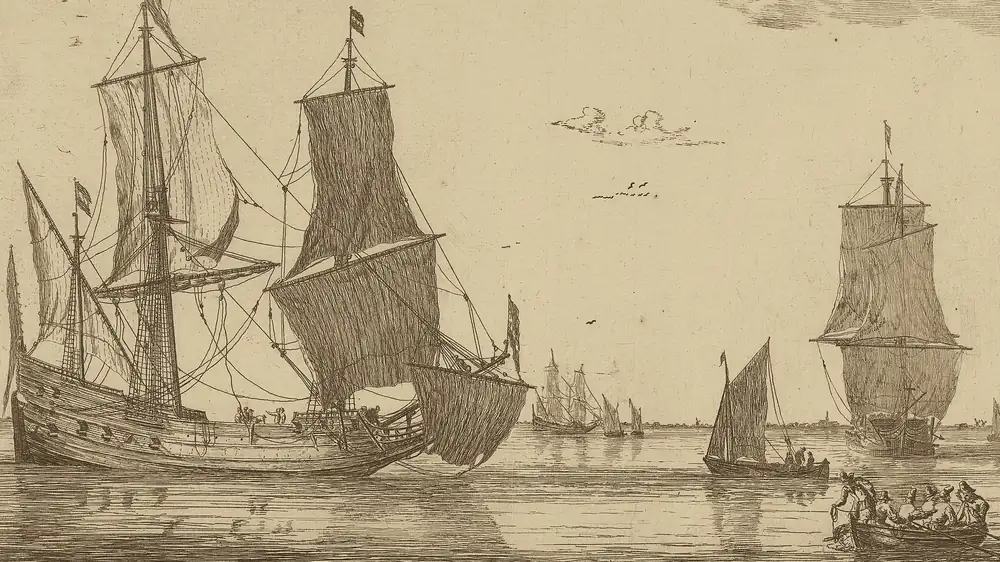
| Born | Plymouth, England (date unknown) |
| Also spelled | Condon, Congdon, Connor |
| Active | About 1718–1720 |
| Ship | Flying Dragon |
| Died | Reportedly in France, date unknown |
Out of Nassau
Condent was one of the Nassau pirates who refused Woodes Rogers’ pardon in 1718. Johnson’s General History says he sailed in a sloop and got command after a quarrel aboard, when the crew turned to him. He took ships off the Cape Verde Islands and in the South Atlantic. Off Brazil he captured a Dutch ship and renamed her the Flying Dragon.
A reputation for cruelty
Johnson records that Condent’s crew were especially cruel to Portuguese captives, cutting off noses and ears. As with many pirates, this story comes mainly from Johnson, and is hard to confirm.
The Indian Ocean
Condent rounded the Cape of Good Hope and reached Madagascar in 1719. There he met the remains of earlier pirate crews. In 1720 he sailed to the coast of India. Near Bombay he took a large Arab ship carrying a fortune in coin and goods. According to Johnson each man took about £2,000, which would have made them rich. Condent then returned to Madagascar, where the crew broke up.
Rivals and hosts
Condent arrived at a crowded moment. Edward England, John Taylor and Olivier Levasseur were all at work in the same waters, and the East India Company’s ships were on alert after England’s fight with the Cassandra at Johanna. The pirates’ bases on Madagascar, built up in the 1690s, still offered food, women, trade and a place to careen. But the island’s Malagasy rulers, Dutch and French slavers, and old pirates who had settled there all had their own interests. A crew that misjudged them could be killed.
A French pardon
Condent and some of his men sailed to Réunion, then the French Île Bourbon. Its governor offered them a pardon in return for surrendering their ship. Condent is said to have married the governor’s sister-in-law or a relative, and then moved to France. According to later accounts he settled in Saint-Malo as a shipowner. If so, he was one of the few pirate captains of the age to retire in comfort.
Why he stands out
Condent is a good example of the second Pirate Round after the end of the Republic of Pirates. His haul helps explain why some Nassau pirates chose the far side of the world over the King’s Pardon. Most who did that died at sea or on the gallows. Condent, like Henry Every, simply vanished into respectable life.
How much is known
Almost everything known about Condent comes from Johnson and from a few East India Company and French colonial records. Even his name is uncertain. Historians treat the story of his retirement in Saint-Malo with caution, since it rests on later tradition rather than documents.
In the game
Condent left the same Nassau waterfront that Free Nassau’s captains know. See Characters & Historical Figures.
Sources and further reading
- Captain Charles Johnson, A General History of the Pyrates (London, 1724). Project Gutenberg.
- Arne Bialuschewski, “Between Newfoundland and the Malacca Strait: A Survey of the Golden Age of Piracy, 1695–1725”, Mariner’s Mirror 90 (2004).
- David Cordingly, Under the Black Flag (Random House, 1995).
- Colin Woodard, The Republic of Pirates (Harcourt, 2007).