Naval Guns and Gunnery
History · sources at the end · the game’s fiction is kept separately
Iron, powder and a well-drilled crew.
| Common sizes | 3- to 12-pounders on sloops and merchantmen |
| Crew per gun | About 4–6 for a light gun; 10–14 for a heavy one |
| Rate of fire | A shot every few minutes for most crews |
| Shot types | Round, chain, bar, grape, canister, langrage |
Around 1700, ship’s guns were cast-iron or bronze muzzle-loaders mounted on wooden carriages. Their size was given by the weight of the iron ball they fired, so a six-pounder fired a ball of about six pounds. Pirate sloops usually carried light guns, from about 2 to 8 pounds, while large warships carried 24- and 32-pounders on their lower decks.
Loading and firing
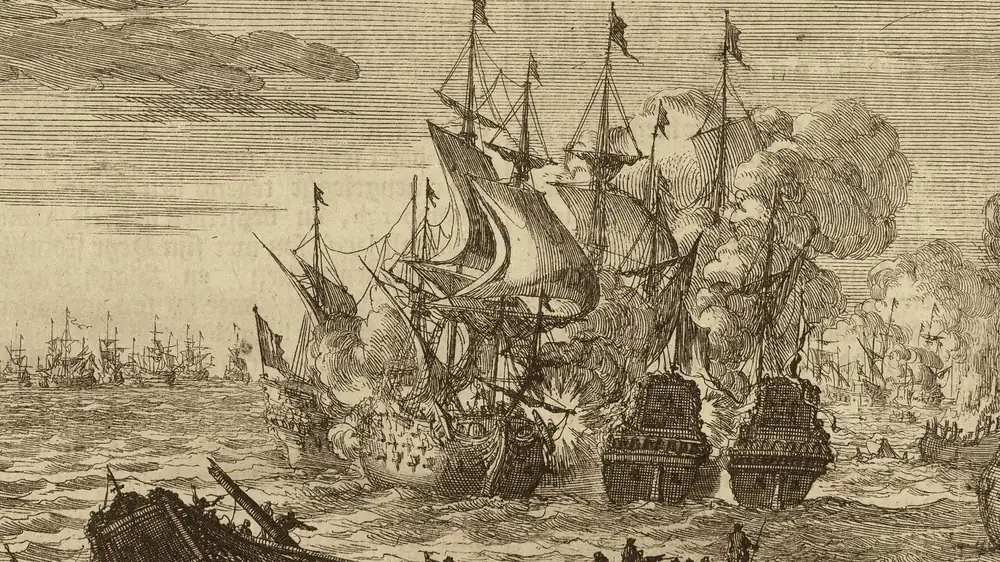
Firing a gun was a team job. The crew sponged out the barrel to put out embers, rammed home a cartridge of powder, then the shot and a wad to hold it. The gun was run out through its port with tackles, aimed by levering the carriage and adjusting a wedge called a quoin, and fired by touching a slow match or linstock to powder in the touch-hole. Recoil drove the gun back until heavy ropes, the breechings, stopped it. A well-drilled navy crew might fire every couple of minutes; merchant and pirate crews were usually slower.
Kinds of shot
- Round shot: a solid iron ball, used against hulls and masts.
- Chain shot and bar shot: two balls or half-balls joined by a chain or bar, which spun through the air and cut rigging and sails.
- Grapeshot and canister: bags or tins of small balls that spread like a giant shotgun, used against crews on an open deck.
- Langrage: scrap iron, nails and odd metal, a cheap alternative used by privateers and pirates.
Swivel guns and small arms
Swivel guns were small cannon on pivots at the rail, firing a ball of about half a pound or a charge of small shot. They were cheap, needed only one or two men and were especially useful against boats and boarders. Muskets, pistols and grenades, called grenadoes, were used heavily when ships came close.
Powder
Gunpowder was kept in a magazine below the waterline, lined to keep out sparks and damp. Boys called powder monkeys carried cartridges up to the guns during action. Fire and explosion were the greatest dangers aboard a wooden ship, and a single spark in the magazine could destroy her.
How pirates used guns
Pirates wanted to capture ships, not sink them, because a sunken prize paid nothing. Most of their targets were merchantmen with small crews who surrendered after a warning shot and the sight of the black flag. When pirates did fire, it was usually to damage rigging so the target could not escape, or to clear her deck with grapeshot before boarding. Long gun battles were rare, and the pirates usually lost them when they met a real warship, as Bartholomew Roberts did in 1722.
Surviving guns
More than twenty cannon have been raised from the wreck of Queen Anne’s Revenge, some of them still loaded. Their mix of English and Swedish guns of different sizes shows how pirates armed their ships with whatever they captured.
In the game
Gun cards such as Broadside, Chain Shot, Grapeshot and Swivel Gun are named after the real weapons on this page. See the Charles Vane captain guide and the glossary.
Sources and further reading
- Brian Lavery, The Arming and Fitting of English Ships of War, 1600–1815 (Conway, 1987).
- Adrian B. Caruana, The History of English Sea Ordnance, 1523–1875, vol. 1 (Jean Boudriot, 1994).
- Mark U. Wilde-Ramsing and Charles R. Ewen, “Beyond Reasonable Doubt: A Case for Queen Anne’s Revenge”, Historical Archaeology 46 (2012).
- David Cordingly, Under the Black Flag (Random House, 1995).
Category: Ships and seafaring · History
See also
Strategy guides
The game’s cannon cards have rules of their own. Card synergies and play order covers the order to play them in, and Boarding versus sinking covers when to stop firing.