The Guarda Costas
History · sources at the end · the game’s fiction is kept separately
Spain’s answer to smugglers, and sometimes pirates themselves.
| What | Privately owned ships commissioned by Spanish colonial governors |
| Bases | Havana, Santo Domingo, Puerto Rico, Cartagena, St Augustine |
| Target | Foreign smugglers trading with Spanish colonies |
| Famous incident | Robert Jenkins’ ear, 1731 |
| Led to | The War of Jenkins’ Ear, 1739 |
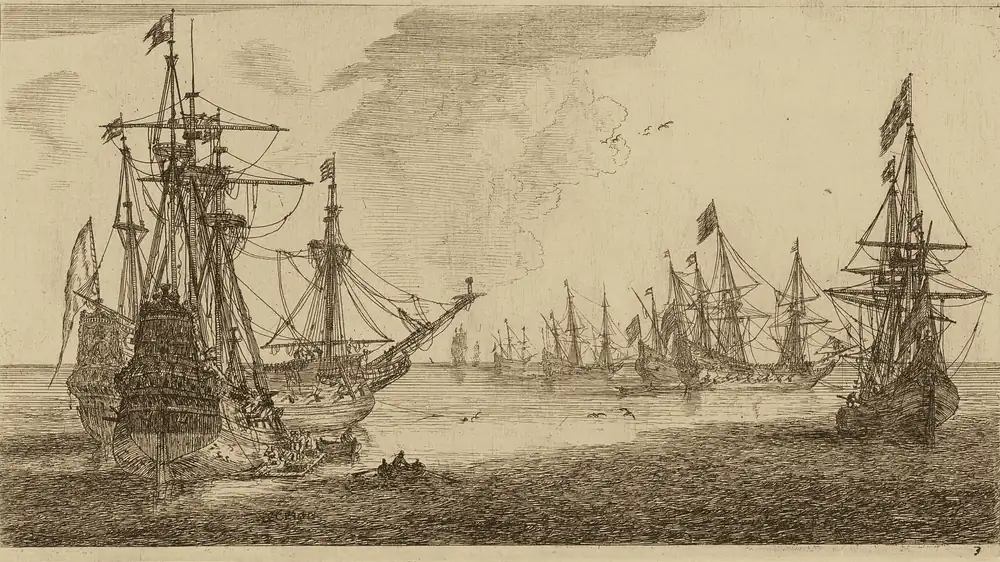
The guarda costas (“coast guards”) were armed ships licensed by Spanish colonial governors to stop foreign trade with Spain’s American colonies. They were usually privately owned and paid from the ships and cargo they seized, which made them, in effect, privateers in peacetime.
Why Spain needed them
Spain’s law allowed its American colonies to trade only with Spain, through licensed fleets. But Spanish goods were expensive and scarce, and English, Dutch and French merchants were happy to sell slaves, cloth and tools directly to colonists for silver. Smuggling was everywhere. The regular Spanish navy was too small to patrol thousands of miles of coast, so governors commissioned local captains to do it.
How they worked
A guarda costa captain received a commission from a governor and kept most of what he took, after the Crown’s and governor’s shares. That gave him every reason to find guilt. Possession of Spanish coins, cocoa or logwood could be treated as proof of smuggling, even on a ship sailing between British colonies. British merchants complained that the guarda costas were no better than pirates, and some were. Crews were often recruited from the same mixed waterfront population as pirate crews.
Ships and crews
Guarda costas were usually sloops, schooners or small brigantines, chosen for speed in shallow coastal water rather than for heavy guns. Many carried large crews for boarding. Captains came from Spain, the colonies and sometimes other nations; Irish and other Catholic exiles served with Spanish forces. A seized ship and cargo was taken before a colonial court for condemnation, and British owners rarely saw them again.
Guarda costas and the pirates
For the pirates of Nassau, the guarda costas and the Spanish governors behind them were a constant danger. Spain regarded the Bahamas as a nest of thieves after the 1715 wreck raids by Henry Jennings and others. Spanish forces from Havana had sacked Nassau in 1703–1704, and an attack in 1720 was beaten off. Some pardoned pirates later served on British anti-Spanish privateers when war returned in 1718.
Jenkins’ ear
In 1731 a guarda costa boarded the British brig Rebecca, commanded by Robert Jenkins, off Cuba. According to Jenkins, the Spanish captain, Julio León Fandiño, cut off his ear. Years later, in 1738, Jenkins is said to have shown the ear to a committee of the House of Commons. Whether or not he did, the story became a rallying cry for merchants and politicians who wanted war with Spain.
The War of Jenkins’ Ear
Britain declared war on Spain in October 1739. Admiral Edward Vernon took Portobelo that year, but a huge attack on Cartagena in 1741 failed with heavy losses, mostly from disease. The war merged into the wider War of the Austrian Succession and ended in 1748. The guarda costas continued to sail through the century.
Two views
Whether a guarda costa was a coast guard, a privateer or a pirate depended on who you asked. To Spain they protected the empire; to British merchants they were robbers with paperwork, much as the Spanish saw English privateers.
Sources and further reading
- Philip Woodfine, Britannia’s Glories: The Walpole Ministry and the 1739 War with Spain (Boydell, 1998).
- Kris Lane, Pillaging the Empire (M. E. Sharpe, 1998).
- Colin Woodard, The Republic of Pirates (Harcourt, 2007).
- David Cordingly, Under the Black Flag (Random House, 1995).
Category: Ships and seafaring · History