The Royal Navy and the Pirate Hunters
History · sources at the end · the game’s fiction is kept separately
It took a decade, a few determined captains, and a lot of reward money.
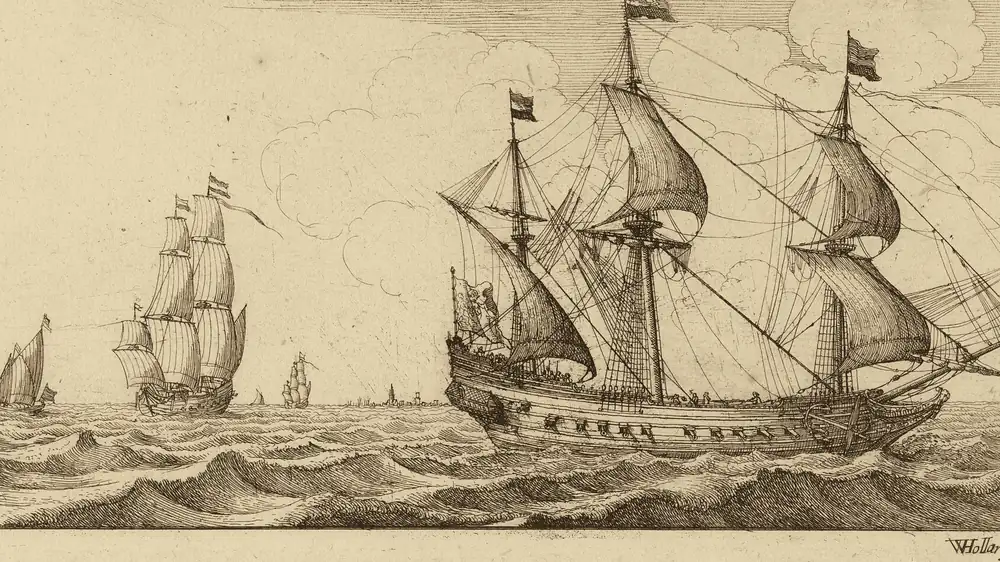
| Main tools | Station warships, hired sloops, colonial militia, rewards |
| Key actions | Cape Fear 1718, Ocracoke 1718, Cape Lopez 1722 |
| Rewards | 1717 proclamation: £100 for a captain, down to £20 for a seaman |
| End | Atlantic piracy largely over by about 1726 |
Too few ships
In 1716 the Royal Navy had only a handful of small warships in the Americas, stationed at Jamaica, Barbados, Virginia, New York and New England. Their captains were often more interested in trading on the side than in chasing pirates. Big warships could not follow pirate sloops into shallow inlets. The navy also had trouble keeping crews: sailors deserted to merchant ships, and some to the pirates.
The Crown’s response
In September 1717 the Crown issued the proclamation that offered the King’s Pardon and also rewards for capturing pirates who refused it: £100 for a captain, less for officers, and £20 for a common seaman. More ships were sent, and governors were told to cooperate. The Piracy Act of 1700 already let colonial courts hang pirates on the spot. See Pirate Trials and the Law.
Colonial hunters
Some of the most important blows came from colonial volunteers. In September 1718 Colonel William Rhett led two armed sloops from Charles Town and caught Stede Bonnet in the Cape Fear River after a long fight on the sandbars. In November 1718 Governor Alexander Spotswood of Virginia paid for two hired sloops under Lieutenant Robert Maynard of HMS Pearl. They found Blackbeard at Ocracoke and killed him. In Jamaica, the privateer Jonathan Barnet took Calico Jack Rackham in 1720.
Pardoned pirates as hunters
Woodes Rogers used former pirates. Benjamin Hornigold hunted his old comrades, bringing in the men who were hanged at Nassau in December 1718. See The Nassau Hangings.
Cape Lopez, 1722
The biggest naval victory came off West Africa. In February 1722 Captain Chaloner Ogle in HMS Swallow found Bartholomew Roberts at Cape Lopez in modern Gabon. Roberts was killed by grapeshot in the opening broadside, and his crew surrendered. Ogle was knighted, the only naval officer honoured for action against pirates in the period. The trial at Cape Coast Castle followed.
The end
By the mid-1720s, more warships, better cooperation between colonies, regular trials and the loss of safe havens had broken Atlantic piracy. The last great captains, such as Edward Low and William Fly, were gone by 1726. See The Golden Age of Piracy.
Prize money and motives
Naval officers had little incentive to chase pirates at first. Pirates rarely carried enough plunder to pay prize money, and a fight with a desperate crew was dangerous. The rewards of 1717, and later the plunder of ships like Roberts’, changed that. Ogle’s men fought for years in court over the value of the goods taken at Cape Lopez. Colonial governors such as Spotswood also had political reasons. Spotswood sent Maynard into North Carolina, another colony, without its governor’s permission, which caused a long dispute.
In the game
Pirate hunters and naval ships are the hardest enemies in Free Nassau. See Ships, Stores & Crew.
Sources and further reading
- Captain Charles Johnson, A General History of the Pyrates (London, 1724). Project Gutenberg.
- N. A. M. Rodger, The Command of the Ocean (Allen Lane, 2004).
- Peter Earle, The Pirate Wars (Methuen, 2003).
- Colin Woodard, The Republic of Pirates (Harcourt, 2007).
- David Cordingly, Under the Black Flag (Random House, 1995).
Category: Ships and seafaring · History
See also
Strategy guides
The game’s pirate-hunter squadron and the rest of its enemies are covered in Enemies and act bosses.