Treasure Island and the Real Pirates
History · sources at the end · the game’s fiction is kept separately
Stevenson invented Flint. A good many of the men around him were real.
| Written | Begun at Braemar, Scotland, in 1881 |
| Published | Serial in Young Folks, 1881–82; book, 14 November 1883 |
| His sources, in his words | Poe, Defoe, Washington Irving, “a copy of Johnson’s Buccaneers,” and Kingsley’s At Last |
| Real names | Israel Hands, Edward England, Bartholomew Roberts, Howell Davis, William Kidd, Blackbeard |
It started with a map
In the summer of 1881 Robert Louis Stevenson was stuck indoors by the rain at Braemar in the Scottish Highlands with his family, including his twelve-year-old stepson, Lloyd Osbourne. He drew a map of an island to amuse the boy, and the story grew out of it. “The map was the chief part of my plot,” he wrote later. He began writing on “a chill September morning,” under the title The Sea Cook. It ran in the boys’ magazine Young Folks in 1881 and 1882 under the name Captain George North, and came out as a book on 14 November 1883.
What he borrowed
Stevenson was honest about his magpie habits. In his essay “My First Book” he listed his materials: “A few reminiscences of Poe, Defoe, and Washington Irving, a copy of Johnson’s Buccaneers, the name of the Dead Man’s Chest from Kingsley’s At Last, some recollections of canoeing on the high seas, and the map itself.” In an 1884 letter he put it more simply. The book came out of Kingsley and “out of the great Captain Johnson’s History of the Notorious Pirates.”
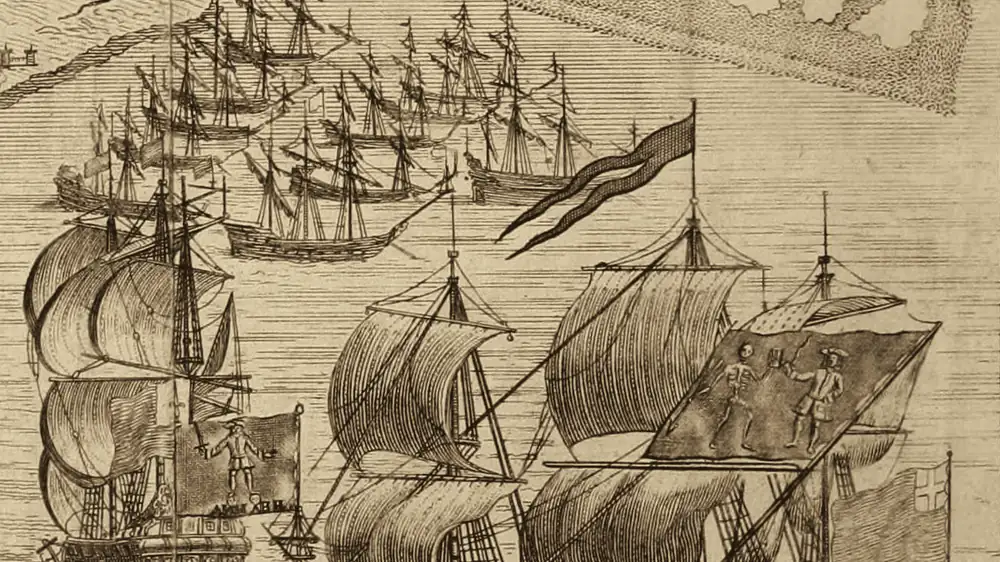
That is A General History of the Pyrates, the 1724 book this wiki leans on too. Once you know that, real names start turning up all over the novel.
The real names
Israel Hands is the Hispaniola’s coxswain, and “had been Flint’s gunner in former days.” The real Hands was Blackbeard’s sailing master, shot in the knee by his own captain, and pardoned in Virginia in 1719.
Edward England is Silver’s first captain. “First with England, then with Flint, that’s my story,” he says, and the parrot “sailed with England, the great Cap’n England, the pirate.” England was real, and his crew marooned him on Mauritius in 1720.
The Viceroy of the Indies. Silver says the Cassandra “brought us all safe home from Malabar, after England took the viceroy of the Indies.” The real capture, of a Portuguese ship carrying the former viceroy of Goa, happened at Réunion in April 1721. It was made by John Taylor and Olivier Levasseur, in the Cassandra, after England had already been deposed. Stevenson simply gave it to the better-known name.
Roberts’s men. Silver’s surgeon was “hanged like a dog, and sun-dried like the rest, at Corso Castle. That was Roberts’ men.” Corso Castle is Cape Coast Castle, where the survivors of Roberts’s crew were tried and hanged in 1722. Silver also grumbles about Roberts’s habit of “changing names to their ships—Royal Fortune and so on.” Roberts did give that name to more than one ship.
Davis, “a man too, by all accounts,” is Howell Davis, the Welsh captain who brought Roberts into piracy. Kidd gets an anchorage on the map. Blackbeard gets a line from the squire: “Blackbeard was a child to Flint.”
Where the fiction takes over
Flint, his crew, his island and his treasure are all invented. So is the treasure map with its cross. Stevenson said the pointing skeleton came from Poe’s “The Gold-Bug,” the parrot from Robinson Crusoe, and much of Billy Bones from Washington Irving. Long John Silver owed something to his friend the poet W. E. Henley, who had lost a leg. Stevenson told Henley it was “the sight of your maimed strength and masterfulness” that begot Silver.
Some of the fiction is very well informed, though. Silver being Flint’s quartermaster is exactly right for a clever, persuasive man in a pirate company (see Pirate Crew Roles), and Ben Gunn is a fair picture of what marooning did to a man. For what the novel got wrong, see Pirate Myths.
In the game
Free Nassau sticks to real crews and real captains. The one name it shares with the novel is Israel Hands, who signs on as a Master Gunner, the job Stevenson gave him. Play in your browser.
Sources and further reading
- Robert Louis Stevenson, Treasure Island (Cassell, 1883).
- Robert Louis Stevenson, “My First Book: Treasure Island”, The Idler (1894).
- Sidney Colvin (ed.), The Letters of Robert Louis Stevenson (1899).
- Charles Kingsley, At Last: A Christmas in the West Indies (1871).
- Captain Charles Johnson, A General History of the Pyrates (London, 1724). Project Gutenberg.
Category: Sources and legends · History