Israel Hands
History · sources at the end · the game’s fiction is kept separately
Blackbeard shot him under the table. It probably saved his life.
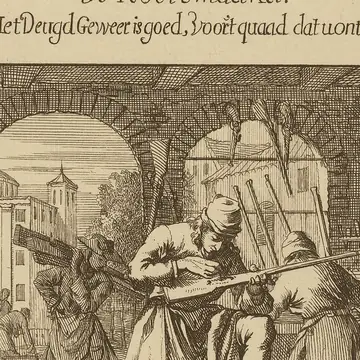
| Active | 1717–1718 |
| Served under | Edward Teach (Blackbeard) |
| Posts | Sailing master of Queen Anne’s Revenge; captain of the sloop Adventure |
| Fate | Condemned in Virginia in 1719, then pardoned; later life unknown |
Israel Hands is one of the few men in Blackbeard’s company we can follow by name from start to finish, and nearly everything we know comes in a handful of lines. Nothing is recorded of where he was born or how he came to sea. Johnson calls him Israel Hands. The minutes of the North Carolina council in May 1719 call him “Hesikia Hands, master of Capt Thaches Sloop Adventure.” Either way, he turns up in the spring of 1718 as one of the men Teach trusted most.
Master, then captain
A sailing master ran the navigation and the handling of the ship, so it was a post for a man who really knew his business. Johnson names Hands as “Master of Teach’s Ship,” the Queen Anne’s Revenge. In early April 1718, at Turneffe off the Bay of Honduras, the fleet took a Jamaica sloop called the Adventure, David Herriot master, and Teach sent “a Number of other Hands with Israel Hands” to sail her “for the pyratical Account.” So for a few months Hands had a command of his own.
It ended in June 1718 at Topsail Inlet in North Carolina. The flagship ran aground, and when Hands brought his sloop in to help pull her off, she grounded too and both were lost. Johnson thought Teach did it on purpose, to shed most of the company and keep the plunder for a few. Hands was one of the few. He stayed on as master of Teach’s sloop.
The shot under the table
This is the story everyone remembers, and Johnson is the only one who tells it. One night Teach was drinking in his cabin with Hands, the pilot and another man. He quietly cocked a small pair of pistols under the table. The third man saw it and slipped up on deck. Teach blew out the candle, crossed his hands and fired. Hands was “shot thro’ the Knee, and lam’d for Life.” Asked why, Teach only said that “if he did not now and then kill one of them, they would forget who he was.”
Nobody else confirms it, and Johnson liked to make Teach look like a devil. But Hands certainly was not in the last fight, and a ruined knee is as good a reason as any.
Ocracoke and the trial
When Lieutenant Robert Maynard caught Teach at Ocracoke on 22 November 1718, Hands was ashore at Bath Town. He was picked up in the round-up afterwards and taken to Virginia with the other prisoners (see Blackbeard’s Last Fight and Alexander Spotswood). According to Johnson he was tried and condemned with the rest. Then, just before the hangings, a ship came in with a proclamation extending the time allowed for the King’s pardon. Hands pleaded it, and it was allowed.
He also gave evidence. His deposition was used against Tobias Knight, North Carolina’s secretary, who was accused of trading with Teach. Knight answered at the council that Hands had sworn to things he could not have seen, and that he had been “kept in prison under the Terrors of Death” before he talked. The council cleared Knight.
After 1719
Johnson, writing in 1724, ends the story with one line: Hands “is alive at this Time in London, begging his Bread.” That is the last anyone hears of him. An Israel Hynde, aged 30, of Bristol, appears among Bartholomew Roberts’s men hanged at Cape Coast Castle in 1722, and some writers have wondered if he was the same man. Nothing but the first name connects them.
In Treasure Island
Robert Louis Stevenson took the name for Treasure Island. His Israel Hands is the Hispaniola’s coxswain, a “careful, wily, old, experienced seaman” who “had been Flint’s gunner in former days,” and he chases Jim Hawkins up the rigging in one of the best scenes in the book. See Treasure Island and the Real Pirates.
In the game
Israel Hands is one of the Master Gunners you can sign on. His first cannon card in each fight costs no energy, and he brings the Double-Shotted card to your Ship deck. The game makes him a gunner, as Stevenson did. The real man was a sailing master. See Pirate Crew Roles and How to Play.
Sources and further reading
- Captain Charles Johnson, A General History of the Pyrates (London, 1724). Project Gutenberg.
- Minutes of the North Carolina Governor’s Council, 27 May 1719, in William L. Saunders (ed.), The Colonial Records of North Carolina, vol. 2 (1886).
- Colin Woodard, The Republic of Pirates (Harcourt, 2007).
- Robert Louis Stevenson, Treasure Island (Cassell, 1883).