Pirate Crew Roles, Captain to Cook
History · sources at the end · the game’s fiction is kept separately
The captain gave the orders in a fight. The rest of the time it was more complicated.
| Elected | Captain and quartermaster |
| Skilled officers | Sailing master, boatswain, gunner, carpenter, surgeon |
| Shares (Roberts) | Captain and quartermaster 2; master, boatswain and gunner 1½; other officers 1¼; everyone else 1 |
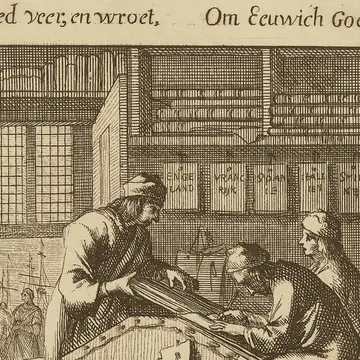
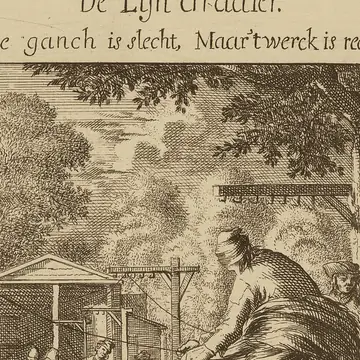
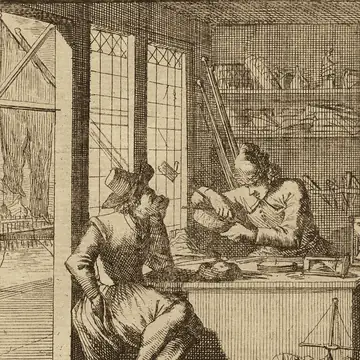
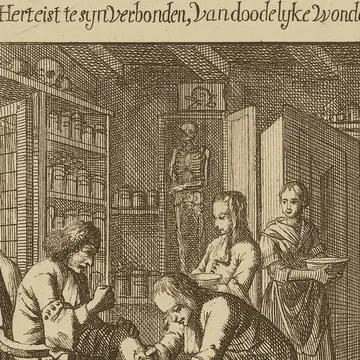
| Pictures | Period trade engravings by Jan and Caspar Luyken stand in; no portraits of these men survive |
A merchant ship around 1700 had a captain appointed by the owners, a few mates, and a crew who did what they were told. A pirate company kept most of the same jobs, because a ship still needed sailing, but changed who held the power and why. Most of what we know comes from the articles pirates wrote for themselves and from Johnson’s General History, which describes the arrangement with a mix of disapproval and fascination.
The captain
The crew elected the captain and could vote him out. Johnson’s summary is hard to beat: “they only permit him to be Captain, on Condition, that they may be Captain over him.” He got the great cabin, but any man might walk in, help himself to his food and drink, and swear at him. What he wanted was someone “Pistol Proof,” bold and clever enough to lead.
In one area his word was final. “The Captain’s Power is uncontroulable in Chace, or in Battle.” Outside a fight, he was “governed by a Majority.” Charles Vane found out how that worked in November 1718, when he refused to attack a French ship that turned out to be a man-of-war. He was within his rights in the chase, but afterwards the company voted him out and made his quartermaster captain.
The quartermaster
The quartermaster was the other elected officer, and in day-to-day life he often mattered more. Johnson calls him “a sort of a civil Magistrate on Board.” He settled quarrels, punished small offences, inspected the men’s weapons, and was first aboard every prize to decide what went into the common stock. He was, in Johnson’s phrase, “Trustee for the whole.” In Lowther’s articles, any gold or jewels found on a prize had to be handed to the quartermaster within 24 hours.
It was a natural step up. Vane’s quartermaster was John Rackham, who replaced him. Long John Silver, in Stevenson’s novel, was Flint’s quartermaster, which is exactly the job a clever, persuasive man would hold.
The sailing master
The master, or sailing master, did the navigation and handled the ship. It took real skill, and good navigators were scarce. Israel Hands was Blackbeard’s. When John Phillips’s company of five chose officers in 1723, Johnson records John Nutt as “Master, (or Navigator).” See Navigation in the Age of Sail.
Boatswain, gunner and carpenter
The boatswain looked after the rigging, sails, cables and anchors and kept the deck work moving. The gunner had charge of the great guns, the powder and the shot (see Naval Guns and Gunnery). The carpenter kept the hull, masts and pumps sound, which on a wooden ship in warm water was never finished.
These were the men pirate companies wanted most and often took by force from prizes, along with surgeons and navigators. That is why “I was forced” was the commonest defence at a pirate trial, and why it often worked for skilled men. When the Whydah broke up off Cape Cod in 1717, one of the two survivors was her carpenter, Thomas Davis, and he was acquitted at Boston. See Pirate Trials and the Law.
The surgeon
Lowther’s articles give “the Doctor” a share and a quarter, the same as the mate and gunner. Medicine was hard to come by. When Blackbeard blockaded Charles Town in 1718, what he demanded for his hostages was a chest of medicines.
Everyone else
Most of the company were ordinary seamen sharing equally, one share each. Roberts’s articles even made room for musicians, who were to have rest on the Sabbath, “but the other six Days and Nights, none without special Favour.” Ships’ cooks were often older or injured seamen who could no longer go aloft, which makes Stevenson’s one-legged cook rather a realistic touch.
How the plunder was divided is on its own page: Pirate Pay and Shares.
In the game
Officers in Free Nassau follow these jobs. You can sign on a Quartermaster, Bosun, Master Gunner, Navigator, Surgeon or Boarding Master, and each one adds a card to the deck that suits the work: gunners, navigators and bosuns to the Ship deck, quartermasters and surgeons to the Boarding deck. See How to Play.
Sources and further reading
- Captain Charles Johnson, A General History of the Pyrates (London, 1724). Project Gutenberg.
- Marcus Rediker, Between the Devil and the Deep Blue Sea (Cambridge, 1987).
- Marcus Rediker, Villains of All Nations: Atlantic Pirates in the Golden Age (Beacon, 2004).
Category: Life and customs · History