Henry Every
History · sources at the end · the game’s fiction is kept separately
He took the richest prize of the age and vanished.
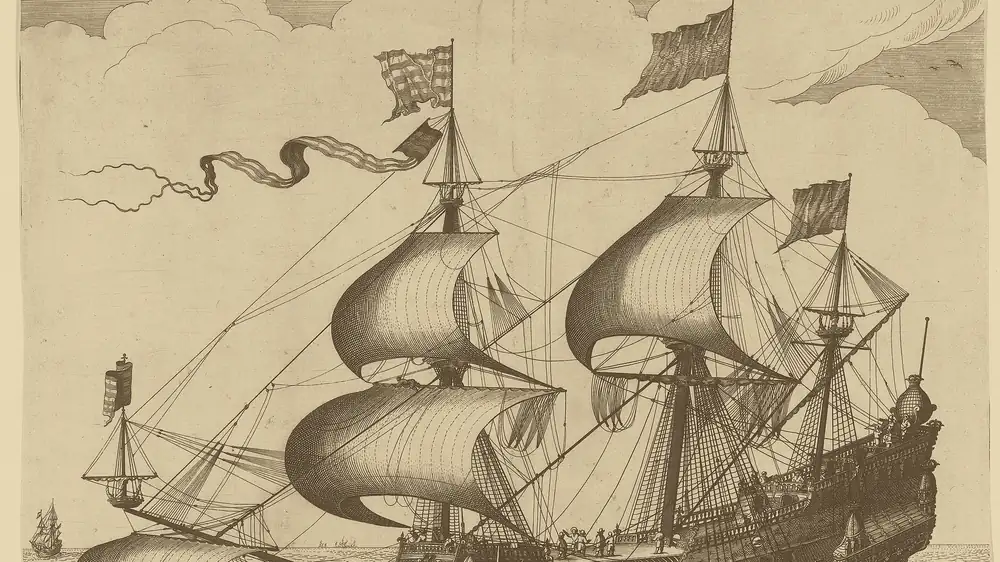
| Born | Devon, England, about 1659 |
| Also called | John Avery, Long Ben |
| Active | 1694–1696 |
| Ship | Fancy (formerly Charles II) |
| Died | Unknown; never caught |
Mutiny at Corunna
In 1694 Every was first mate of the Charles II, part of an English expedition hired by Spain and waiting at Corunna. The crew had gone months without pay. Every led a mutiny, took the ship, renamed her the Fancy, and sailed for the Indian Ocean.
The Ganj-i-Sawai
In 1695 the Fancy joined Thomas Tew and other pirates at the mouth of the Red Sea to wait for the Mughal pilgrim fleet coming home from Mocha. In September they caught the Fateh Muhammed and then the great Ganj-i-Sawai, owned by the emperor Aurangzeb. The pirates took hundreds of thousands of pounds in gold and silver, and committed atrocities against the passengers.
The manhunt
The attack nearly cost the East India Company its trade in India. England and the Company offered large rewards, the first worldwide manhunt. Every sailed to the Bahamas, where the governor at Nassau let his crew ashore, and the crew scattered. Several were caught and hanged in London in 1696. Every was never found. Plays and ballads soon called him the “King of Pirates”, and his story inspired the pirates who later made Nassau their base.
Every and Nassau
Every reached New Providence in 1696 in the Fancy, posing as a slave trader named Henry Bridgeman. The governor, Nicholas Trott, let the crew land in exchange for gifts said to include the ship and a large payment. The crew scattered to the American colonies, Ireland and England. Twenty-four were arrested and six were hanged at Execution Dock in November 1696. The episode helped fix the Bahamas’ reputation as a pirate refuge two decades before the Republic of Pirates.
Every and the East India Company
The emperor Aurangzeb blamed the English. He had Company officers at Surat confined, and he threatened to end the Company’s trade. To save it, the Company offered to escort the pilgrim fleet. It also joined the Crown in offering £500 for Every, later doubled. The search was the first worldwide manhunt. It also led to tougher laws against pirates, including the Piracy Act of 1700. See Pirate Trials and the Law.
Legend
A play, The Successful Pyrate (1712), and many pamphlets made Every a king of Madagascar with a Mughal princess for his wife. Johnson told a less romantic story: Every died poor in Devon, cheated by Bristol merchants who were supposed to sell his jewels. Neither version can be proved. The Mughal chronicler Khafi Khan left an Indian account of the attack. Every inspired the pirates of the 1710s, and Nassau captains still spoke of him.
In the game
At Tavern Fanorona he is the Hard opponent, the only level where tavern silver can be wagered.
Sources and further reading
- Captain Charles Johnson, A General History of the Pyrates (London, 1724). Project Gutenberg.
- Steven Johnson, Enemy of All Mankind (Riverhead, 2020).
- Joel H. Baer, “‘Captain John Avery’ and the Anatomy of a Mutiny”, Eighteenth-Century Life 18 (1994).