Thomas Tew
History · sources at the end · the game’s fiction is kept separately
One rich voyage sent a generation of pirates to Madagascar.
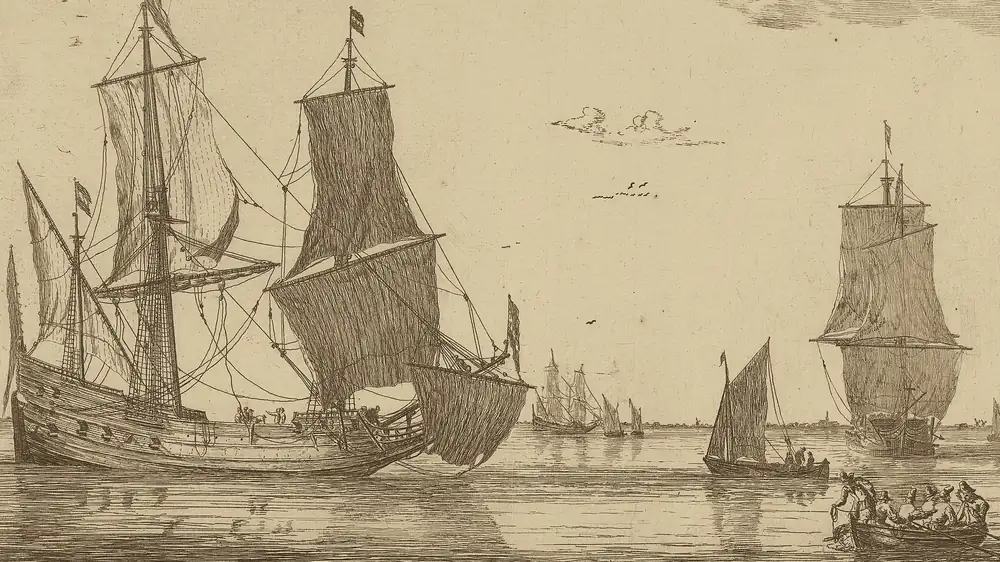
| Home | Newport, Rhode Island |
| Active | 1692–1695 |
| Ship | Amity |
| Died | 1695, in the Red Sea, attacking a Mughal ship |
The Amity
In 1692 Tew sailed from Bermuda in the sloop Amity with a privateering commission against the French on the West African coast. Once at sea he and his crew decided to go pirate instead. They rounded the Cape of Good Hope for the Red Sea.
The Pirate Round
In 1693 the Amity took a rich Indian ship near the Bab-el-Mandeb strait. Tew’s men are said to have shared about £3,000 a man, a fortune. He called at Madagascar on the way home and sold his goods in Newport, where the money bought him respectability. The story of his haul sent many crews from the American colonies on the same voyage, known as the Pirate Round.
Commissions and governors
In the 1690s piracy and colonial government sat close together. Tew’s privateering commission came from the governor of Bermuda. On his return he was welcomed by Benjamin Fletcher, the governor of New York, who later gave him a new commission. Fletcher was recalled in 1698, partly for his dealings with pirates. In Rhode Island, Newport merchants bought pirate goods openly. London later complained that the colonies were “nurseries” of pirates.
The Madagascar connection
Madagascar suited the pirates. It lay off the main route to India, it had good harbours, and it had no European government. On the island of Île Sainte-Marie, the trader Adam Baldridge ran a base for pirate crews, supplied by New York merchants such as Frederick Philipse. Ships from New York brought rum, guns and powder, and carried back plunder and enslaved Malagasy people. See The Pirate Round.
The last voyage
In 1694 Tew sailed again. In 1695 he joined Henry Every and other captains at the mouth of the Red Sea to attack the Mughal pilgrim fleet. Tew was killed attacking one of the ships, the Fateh Muhammed.
Libertalia
Tew had a second life in print. The second volume of Johnson’s General History (1728) tells of a French captain, Misson, who founded a free republic called Libertalia on Madagascar with Tew as his admiral. No record from the time mentions Misson or Libertalia, and historians treat the story as fiction, a political fable about liberty. It still shapes how pirates are imagined today.
In the game
Tavern Fanorona has him as the Easy opponent. Easy games are free play, with no silver at stake.
Sources and further reading
- Captain Charles Johnson, A General History of the Pyrates (London, 1724). Project Gutenberg.
- Arne Bialuschewski, “Pirates, Slavers, and the Indigenous Population in Madagascar, c. 1690–1715”, International Journal of African Historical Studies 38 (2005).
- Robert C. Ritchie, Captain Kidd and the War against the Pirates (Harvard, 1986).