John Gow
History · sources at the end · the game’s fiction is kept separately
A pirate who sailed home and ran aground.
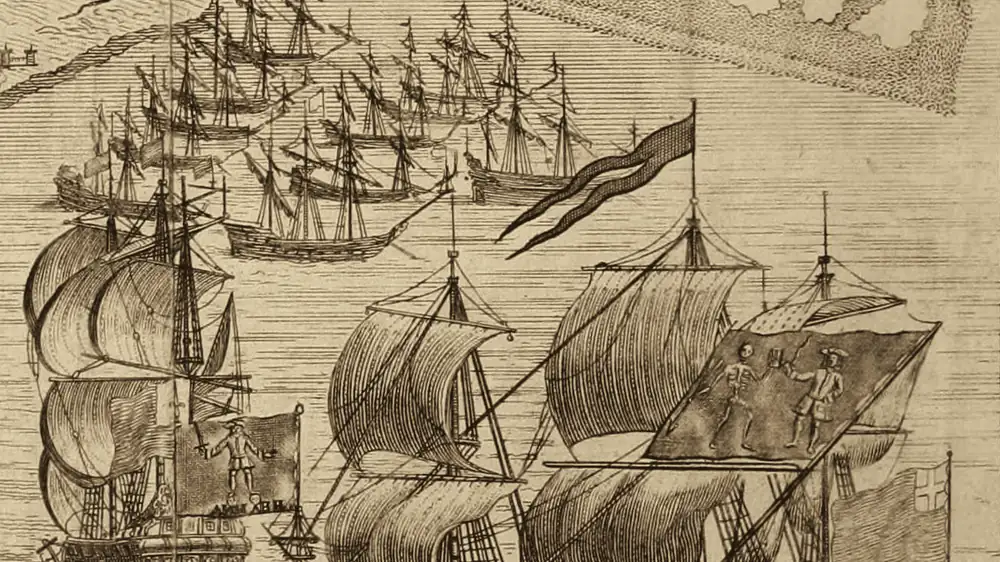
| Born | About 1698, Orkney (raised in Stromness) |
| Ship | George galley, renamed Revenge |
| Captured | February 1725, Calf of Eday, Orkney |
| Died | 11 June 1725, hanged at Execution Dock, London |
John Gow was a Scottish seaman who led a mutiny in 1724 and spent about three months as a pirate captain. His story is unusual because he ended his career not in the Caribbean but in the Orkney Islands off the north of Scotland, where he had grown up.
Mutiny
Gow was serving as second mate and gunner on the George galley, a merchant ship trading to the Mediterranean and North Africa. In November 1724, after a cargo voyage to Santa Cruz on the Barbary coast, he and several others killed the captain and officers at night. The crew elected Gow captain and renamed the ship Revenge.
At sea
The pirates took several merchant ships off Spain and Portugal, mostly carrying fish, wine and other ordinary cargo. They found little money, and a French ship they chased turned out to be too strong to attack. With provisions running short and quarrels in the crew, Gow decided to sail north to Orkney, where he knew the coast and hoped the ship could be refitted without questions.
Orkney, 1725
The Revenge anchored at Stromness in January 1725, and Gow passed himself off as a merchant captain. Several men deserted and reported the truth. Gow then raided the house of Hall of Clestrain and later tried to plunder Carrick House on the island of Eday, home of James Fea, an old schoolfellow. On the way, the ship ran aground on the Calf of Eday. Fea lured Gow ashore under the pretence of talks, captured him and his crew, and handed them over to the authorities.
Trial and death
Gow and his men were taken to London and tried before the Admiralty court. Gow at first refused to plead, and gave way only when threatened with being pressed to death. He was hanged at Execution Dock on 11 June 1725. The rope broke and he had to be hanged a second time. His body was then hung in chains beside the Thames.
Gow in print
A pamphlet on Gow appeared in London within weeks of his death and was later included in the General History of the Pyrates. A century on, Sir Walter Scott heard local stories of Gow while visiting Orkney and used them for his novel The Pirate (1821).
In the game
Gow belongs to the last years of the age, after the period Free Nassau covers. See Pirate Trials and the Law and Pirate Articles & Life at Sea.
Sources and further reading
- An Account of the Conduct and Proceedings of the Late John Gow (London, 1725).
- Captain Charles Johnson, A General History of the Pyrates (London, 1724; 2nd vol. 1728).
- Sir Walter Scott, The Pirate (Edinburgh, 1821), author’s notes.
- David Cordingly, Under the Black Flag (Random House, 1995).