Port Royal, Jamaica
History · sources at the end · the game’s fiction is kept separately
Before Nassau, the richest and rowdiest pirate port in the Caribbean.
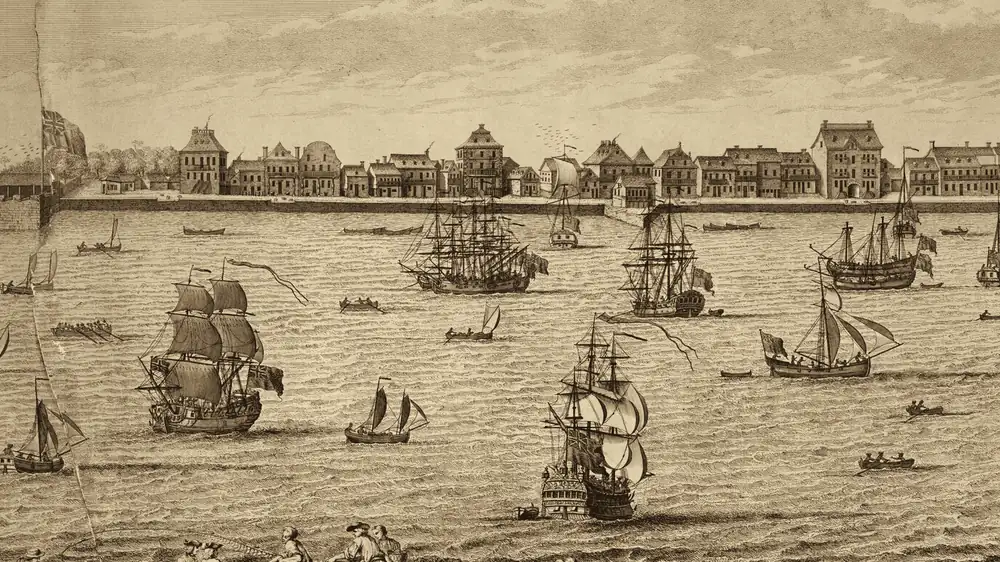
| Founded | After the English took Jamaica from Spain in 1655 |
| Peak | About 1660–1692 |
| Destroyed | 7 June 1692, earthquake and tsunami |
| Later role | Royal Navy base; Rackham tried nearby at Spanish Town in 1720 |
A town on a sandspit
When an English expedition took Jamaica from Spain in 1655, it found a fine natural harbour sheltered by the Palisadoes, a long spit of sand. A fort and then a town grew at its tip. With no strong navy to defend the island, governors invited buccaneers to base themselves there. Their raids on Spanish towns and shipping kept the Spanish away and brought plunder into Jamaica.
The buccaneers
The buccaneers were a mixed population of English, French, Dutch and other sea-raiders who had begun as hunters of wild cattle on Hispaniola. Operating under privateering commissions from the governor, often loosely, they sacked Spanish towns across the region. The most famous, Henry Morgan, took Portobelo in 1668 and Panama in 1671. He was later knighted and served as lieutenant governor of Jamaica, turning against his old companions. Alexandre Exquemelin, a surgeon who sailed with them, wrote the classic account, De Americaensche Zee-Roovers (1678), translated into English as The Buccaneers of America.
The richest town in English America
Plunder made Port Royal rich. By the 1680s it had several thousand people, brick houses, goldsmiths, merchants trading with Spanish colonies, and a famous number of taverns and brothels. By one often-quoted count there was roughly one drinking house for every ten residents. Preachers called it the wickedest city on earth. It was also a major centre of the slave trade, as Jamaica’s sugar plantations grew. Once peace with Spain was agreed in the Treaty of Madrid (1670), Jamaica began to turn against the buccaneers, and laws against piracy were passed in the 1680s.
The earthquake of 1692
Just before noon on 7 June 1692 a great earthquake struck. Much of the town, built on loose sand, liquefied and slid into the harbour. Around two thousand people died at once, and more died of disease in the weeks after. Survivors founded Kingston across the harbour. Underwater archaeology since the 1960s, led by Robert Marx and later by Texas A&M University, has recovered buildings, pewter, clay pipes and a famous pocket watch stopped at 11:43.
Port Royal in the Golden Age
Port Royal survived as a naval station. In the Golden Age it was a hunting base against pirates, not a haven for them. Jamaica sent privateers and naval sloops after the crews of the Republic of Pirates. In 1720 the pirate hunter Jonathan Barnet captured Calico Jack Rackham off western Jamaica, and Rackham was hanged at Gallows Point, Port Royal, his body gibbeted on a small cay still called Rackham’s Cay. Nassau was in some ways the heir of the old buccaneer port: a place where plunder could be sold with no questions asked.
Daily life in the town
Port Royal was crowded and expensive. There was no fresh water on the spit, so water came by boat from the mainland, and almost all food was imported. Merchants traded slaves, sugar, logwood and Spanish silver smuggled from Cartagena and Portobelo. Jewish merchants, Quakers, Anglicans and many others lived side by side. Archaeologists have found clay tobacco pipes by the thousand, Chinese porcelain from the Manila trade, and pewter plates engraved with owners’ initials. Those finds show a town whose ordinary people lived surprisingly well.
In the game
Free Nassau is set in the generation after Port Royal’s fall. See the Places guide.
Sources and further reading
- Alexandre Exquemelin, The Buccaneers of America (English translation, 1684).
- Nuala Zahedieh, “Trade, Plunder, and Economic Development in Early English Jamaica, 1655–89”, Economic History Review 39 (1986).
- Michael Pawson and David Buisseret, Port Royal, Jamaica (Oxford, 1975).
- Donny L. Hamilton, Port Royal Project, Texas A&M Nautical Archaeology Program.
- David Cordingly, Under the Black Flag (Random House, 1995).