William Fly
History · sources at the end · the game’s fiction is kept separately
One of the last pirates of the Golden Age.
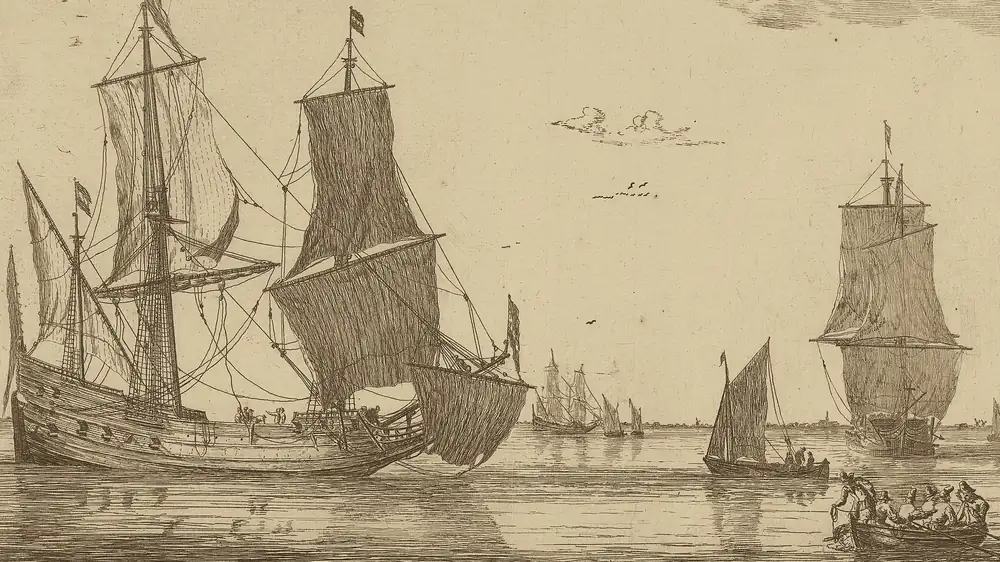
| Ship | Snow Elizabeth, renamed Fame’s Revenge |
| Active | May–June 1726 |
| Captured | June 1726, retaken by prisoners |
| Died | 12 July 1726, hanged at Boston |
William Fly was an English sailor whose brief career is usually treated as the end of the Golden Age of Piracy in the Atlantic. He held command for only a few weeks, but his trial and execution in Boston were widely reported and are unusually well documented.
Mutiny on the Elizabeth
In the spring of 1726 Fly shipped as boatswain on the snow Elizabeth, sailing from Jamaica toward the coast of West Africa under Captain John Green. Fly later claimed the captain had treated the crew harshly. In late May, with several others, he seized the ship at night, and Captain Green and the first mate were thrown overboard. The mutineers elected Fly captain and renamed the ship Fame’s Revenge.
A short cruise
Fly sailed north to the coast of the Carolinas and then New England. He took a handful of vessels and forced a few men to join him, including William Atkinson, an experienced mariner whom Fly wanted as a navigator. Atkinson pretended to cooperate while he looked for a chance to turn the tables. In June, with much of the crew away or drunk, Atkinson and other forced men overpowered Fly and the remaining pirates and sailed the ship into Boston.
Trial and execution
Fly and his fellow mutineers were tried by an Admiralty court in Boston. The minister Cotton Mather visited them in prison and urged them to repent; Fly refused and said he had been driven to mutiny by cruelty. On 12 July 1726 Fly, Samuel Cole and Henry Greenville were hanged. Witnesses said Fly climbed the scaffold with a nosegay in his hand and showed the hangman how to tie the knot properly. His body was hung in chains on Nix’s Mate, a small island in Boston Harbor, as a warning to passing sailors.
Significance
By 1726 the great pirate companies of the previous decade had been hunted down or hanged. Fly lasted one ship and a few weeks at sea, which says a good deal about how hard it had become to survive as a pirate. Historians such as Marcus Rediker read his last words, which blamed captains who abused their crews, as typical of the anger behind many mutinies of the period.
In the game
The game is set ten years before Fly’s mutiny, so he has no part in it. See Pirate Trials and the Law and the timeline.
Sources and further reading
- Cotton Mather, The Vial Poured Out Upon the Sea (Boston, 1726).
- Benjamin Colman, It Is a Fearful Thing to Fall into the Hands of the Living God (Boston, 1726).
- Marcus Rediker, Villains of All Nations: Atlantic Pirates in the Golden Age (Beacon, 2004).
- Captain Charles Johnson, A General History of the Pyrates (London, 1724; 2nd vol. 1728).