Privateering vs Piracy
History · sources at the end · the game’s fiction is kept separately
Same ship, same crew, same guns. The difference was a piece of paper.
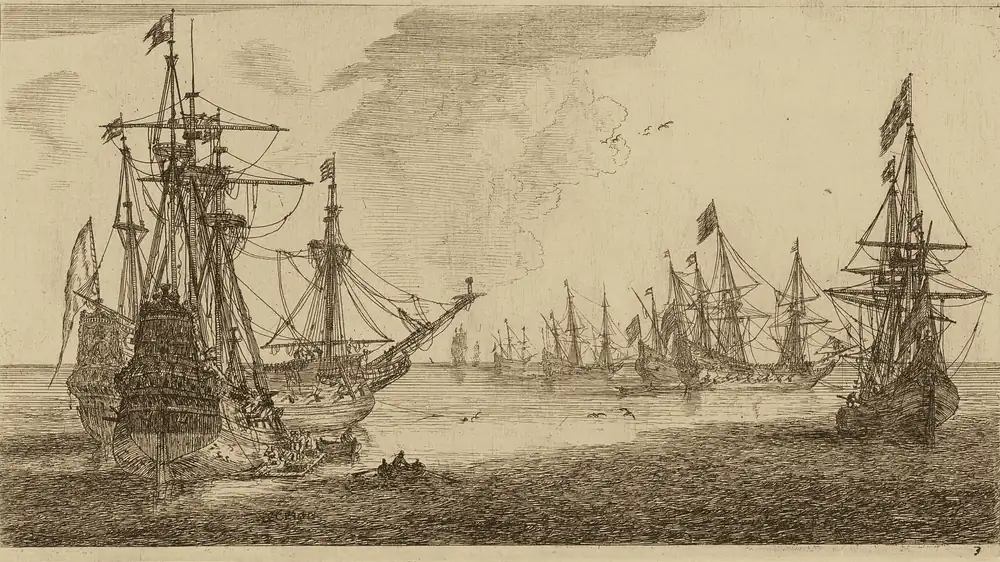
| Privateer | Private ship licensed by a government to attack enemy shipping |
| Licence | Letter of marque or commission |
| Prizes | Judged by an admiralty or prize court |
| Pirate | Attacks any ship without lawful authority |
A licence to plunder
In wartime, European states let private ship owners attack enemy merchant shipping. The owner applied for a letter of marque, gave a bond for good behaviour, and fitted out a ship at his own cost. Captured ships were taken to an admiralty prize court, which decided whether they were lawful prizes. If so, they were sold. The owners, captain and crew shared the money, and the Crown might take a share. Privateering cost governments nothing and hurt the enemy’s trade.
How a privateer was paid
Privateer crews usually sailed “no purchase, no pay”: no prizes, no wages. Shares were set in written articles, much like the pirate articles that came later. Pirate crews kept the privateer system of shares, but dropped the owners, who usually took the biggest part. See Pirate Pay and Shares.
Where the line blurred
The line between privateer and pirate was easy to cross. A captain might attack a neutral ship, or a ship of his own nation, and claim a mistake. Commissions issued by small colonies or foreign governors were of doubtful value. Some captains held commissions from several countries. William Kidd sailed with a royal commission and was hanged as a pirate. Thomas Tew left Bermuda as a privateer and turned pirate at sea. The Spanish guarda costas, licensed to stop smuggling, often seized English ships on thin excuses, and the English called them pirates.
1713: peace and unemployment
The War of the Spanish Succession (1701–1714) put thousands of English privateers to sea in the Caribbean, many from Jamaica. The Treaty of Utrecht in 1713 ended the war and their commissions. The Royal Navy also paid off thousands of sailors. Merchant wages fell. Many of these men had nothing but their skills at sea and with guns. Within a few years, they were the core of the pirate companies at Nassau. Benjamin Hornigold and Henry Jennings both began with something like legal cover. See The Golden Age of Piracy.
Pirates who became privateers
The move went both ways. When war with Spain broke out again in 1718–1720, Woodes Rogers, himself a former privateer, gave commissions to pardoned pirates at Nassau. Hornigold became a pirate hunter. Privateering continued in every major war until the Declaration of Paris abolished it for most European powers in 1856.
How captains justified it
Pirates themselves often used the language of privateering. Some claimed to be at war with Spain long after the peace. Others flew national colours and called their prizes lawful. Samuel Bellamy reportedly mocked merchant captains as slaves to rich men who were the true robbers. To the law, however, the question was simple: without a valid commission against an enemy at war, any capture at sea was piracy, and the punishment was death.
In the game
In Free Nassau you choose your own line: sink, board, or bargain. See How to Play.
Sources and further reading
- Nicholas A. M. Rodger, The Command of the Ocean (Allen Lane, 2004).
- Mark G. Hanna, Pirate Nests and the Rise of the British Empire, 1570–1740 (North Carolina, 2015).
- Janice E. Thomson, Mercenaries, Pirates, and Sovereigns (Princeton, 1994).
- Marcus Rediker, Between the Devil and the Deep Blue Sea (Cambridge, 1987).
Category: Law, trade and money · History