The Barbary Corsairs
History · sources at the end · the game’s fiction is kept separately
For a seaman of 1700, capture by Algiers was a far older fear than any Caribbean pirate.
| Bases | Algiers, Tunis and Tripoli (under Ottoman sovereignty); Salé in Morocco |
| Active | From the 1500s until 1830 |
| Took | Ships, cargoes and above all people, for ransom or slavery |
| Ended | Bombardment of Algiers, 1816; French conquest of Algiers, 1830 |
The pirates in the rest of this wiki had a few busy decades in the Caribbean and the Indian Ocean. The corsairs of North Africa, the coast Europeans called Barbary, worked for about three hundred years. Every English sailor bound into the Mediterranean, or even along the coasts of Spain and Portugal, knew the risk.
Corsairs, not quite pirates
The corsairs sailed with the blessing of their own rulers: the regencies of Algiers, Tunis and Tripoli, which owed allegiance to the Ottoman sultan, and the port of Salé in Morocco. They made war at sea on the Christian states their rulers were not at peace with, and the rulers took a share. To their victims they were pirates. To themselves they were waging lawful, even holy, war. The Knights of Malta did much the same in the other direction, raiding Muslim shipping and selling captives. It is the same blurred line as privateering and piracy, drawn across a religious frontier.
Renegades
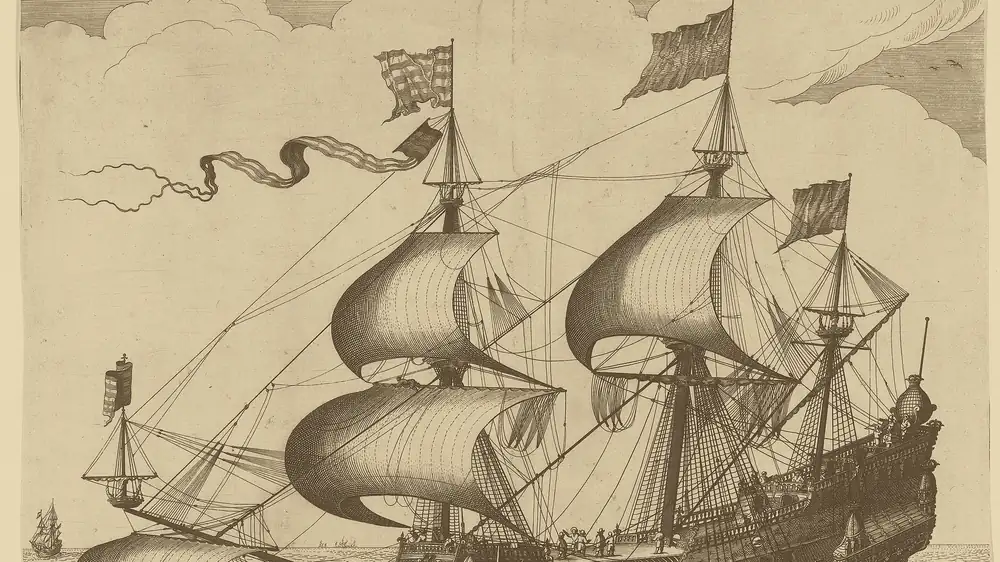
For a long time the corsairs used oared galleys suited to the Mediterranean. Around 1600 European sailors who went over to them brought square-rigged sailing ships and Atlantic seamanship, and the range of the raids grew enormously. Some of the best-known corsair captains were converts. The Englishman John Ward took a ship to Tunis around 1603 and stayed. Jan Janszoon of Haarlem, captured in 1618, converted, took the name Murad, and became one of the leading captains of Salé.
The trade in people
Cargo was welcome, but the real business was people. Crews and passengers were held for ransom or sold. Some ended up rowing galleys for years, others as labourers or servants. Churches, families and governments raised money to buy captives back, and the ransoming of slaves was a regular trade in its own right. The Spanish writer Miguel de Cervantes spent five years as a captive in Algiers before he was ransomed. How many Europeans were taken over the centuries is still argued about. The historian Robert Davis estimated more than a million between 1530 and 1780, and other historians think that is too high.
Raids on the north
The raids that still shock people are the ones far from the Mediterranean. In the summer of 1627 corsairs from Salé and Algiers raided Iceland, killing about fifty people and carrying off close to four hundred. Ransoms for about fifty of them were paid nine to eighteen years later. On 20 June 1631 a force led by Jan Janszoon, now Murad Reis, landed at Baltimore in West Cork, Ireland, and took at least 107 villagers to Algiers. Very few ever came home, and the village was all but abandoned for generations.
In the Golden Age
By the time Nassau was full of pirates, Britain dealt with Barbary mostly by treaty, gifts and the threat of the navy. British ships carried a Mediterranean pass to show corsairs they were protected. The top of each pass was cut off in a wavy, scalloped line, and the matching tops were sent to the Barbary ports, so a corsair captain could check that the edges fitted. Ships of nations without treaties were still fair game.
The Barbary coast turns up in the Atlantic pirate story too. John Gow’s mutiny in 1724 began on a trading voyage to Santa Cruz, on the Moroccan coast.
The end
When the United States lost British protection after independence, its ships became targets, and it fought the Barbary Wars of 1801–1805 and 1815. In August 1816 an Anglo-Dutch fleet under Lord Exmouth bombarded Algiers, and the Dey freed his Christian captives and signed a treaty against enslaving Europeans. The French conquest of Algiers in 1830 finished the corsairs off for good.
Sources and further reading
- Robert C. Davis, Christian Slaves, Muslim Masters (Palgrave Macmillan, 2003).
- Adrian Tinniswood, Pirates of Barbary (Riverhead, 2010).
- Des Ekin, The Stolen Village: Baltimore and the Barbary Pirates (O’Brien Press, 2006).
- Linda Colley, Captives: Britain, Empire and the World, 1600–1850 (Jonathan Cape, 2002).
Category: Events and eras · History